




Abstract
Depression is a leading cause of disability worldwide, with significant personal and societal consequences. Emerging research highlights the critical role of environmental exposures as modifiable risk factors influencing depression risk and progression. Over the past decade, a substantial body of epidemiological evidence has linked diverse environmental factors—including air pollution, limited green space access, chronic noise exposure, adverse features of urbanization, unhealthy lifestyle behaviors, early life adversity, and internal toxicant burdens—to elevated risks of depressive symptoms and clinical depression. These exposures exert their effects through interconnected biological pathways, including chronic systemic inflammation, oxidative stress, hypothalamic-pituitary-adrenal axis dysregulation, blood-brain barrier disruption, and gut microbiota alterations. Recent methodological advances, such as high-resolution environmental exposure assessment, multi-exposure model approaches, longitudinal cohort designs, and enhanced causal inference techniques, have strengthened the evidence base. Nevertheless, challenges remain in accurately characterizing multifactorial exposures and establishing causal relationships across diverse populations. Incorporating a life course perspective and adopting comprehensive exposome frameworks will be essential for future research. Understanding environmental determinants of depression not only advances etiological knowledge but also highlights critical opportunities for prevention. Public health interventions aimed at reducing harmful environmental exposures, enhancing urban green infrastructure, promoting healthy lifestyle behaviors, and mitigating psychosocial stressors offer promising strategies for reducing the burden of depression. Ultimately, integrating environmental health perspectives into mental health research and policy may provide transformative approaches to preventing and alleviating depression at the population level.
Keywords:Depression, Environmental risk factors, Epidemiology, Biological pathways, Public health strategies
Introduction
Depression is one of the most prevalent and debilitating mental disorders globally, significantly contributing to the overall burden of disease and disability [1] . Earlier studies of depression have mainly highlighted genetic vulnerability [2] , neurobiological alterations [3] , and psychological factors [4] as key contributors to its development. However, a growing body of research emphasizes the importance of environmental exposures as crucial, modifiable contributors to depression risk and progression [5,6] . Environmental exposures encompass a wide array of external and internal factors encountered throughout the life course, influencing brain development, neurochemical pathways, and stress response systems [7] .
The concept of the exposome, first introduced by Wild in 2005 and later expanded, provides a comprehensive framework for studying environmental determinants of health [8,9] . The exposome encompasses the totality of environmental exposures across the lifespan and is typically divided into three domains [8] : general external exposures, such as air pollution, climate, and urbanization; specific external exposures, including individual-level factors like diet, physical activity, smoking, and psychosocial stressors; and internal exposures, which refer to biological responses to external influences, such as inflammation, oxidative stress, metabolic alterations, and toxicant accumulation. Within this framework, mental health research increasingly recognizes that the environment, in its broadest sense, plays a pivotal role in shaping the risk for depression [10,11] . Epidemiological studies have linked diverse environmental exposures, including air pollution [12] , green space availability [13] , noise [14] , urban density [15] , diet quality [16] , physical activity [17] , heavy metals [18] , and early life adversity [19] , to depression incidence and severity. Furthermore, biological mechanisms such as chronic inflammation [20] , oxidative stress [21] , neuroendocrine dysregulation [22] , blood-brain barrier disruption [23] , and gut microbiota alterations [24] have been proposed to mediate the effects of environmental insults on mood regulation and neuroplasticity.
Although significant progress has been made, major challenges persist in clarifying the impact of environmental exposures on depression. Key obstacles include the accurate characterization of complex and dynamic exposures, the identification of causal relationships within multifactorial systems, and the translation of research findings into effective and scalable public health interventions. Addressing these issues requires a comprehensive framework that integrates multiple exposure types, epidemiological insights, mechanistic understanding, and policy relevance. In this review, we systematically synthesize current evidence by classifying exposure domains, summarizing epidemiological associations, describing biological mechanisms, and evaluating methodological limitations. We also propose future directions to improve causal inference, refine exposure assessment, enhance population diversity, and guide prevention strategies. This integrative perspective highlights the essential role of environmental factors in advancing mental health research and informing public policy.
Types of Environmental Exposures
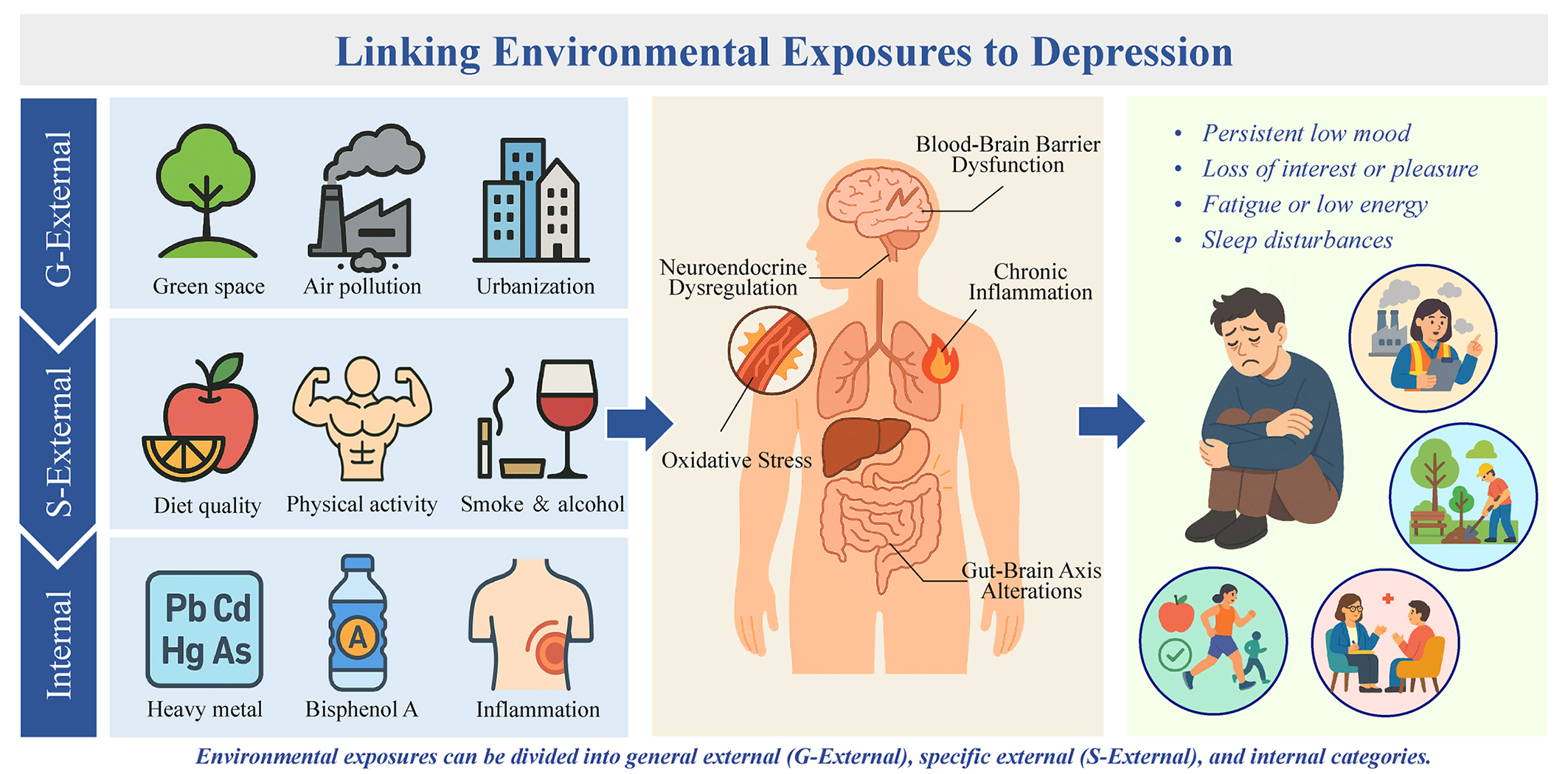
Environmental exposures relevant to depression research can be broadly categorized into three inter-related domains: general external exposures, specific external exposures, and internal exposures [9] . This classification not only reflects the diversity of environmental factors but also facilitates a structured understanding of their potential roles in influencing depressive outcomes. To visually summarize this classification, Figure 1 illustrates how general external, specific external, and internal exposures are associated with depression through distinct yet interconnected mechanisms.
Figure 1. Overview of environmental exposures contributing to depression.This figure summarizes the three domains of the exposome and illustrates how general external exposures (e.g., air pollution), specific external exposures (e.g., diet, physical activity), and internal processes (e.g., inflammation, oxidative stress) may collectively relate to depression risk. General external exposures (blue background) include urbanization, limited green space, air pollution, noise and so on. Specific external exposures (green background) reflect modifiable lifestyle and psychosocial factors, such as poor diet quality, physical inactivity, and related behaviors. Internal exposures (pink background) involve biological alterations within the body, including, but not limited to, heavy metal accumulation, endocrine disruptors, and other internal physiological changes. Collectively, these domains illustrate the multidimensional and interconnected nature of environmental contributions to depression risk.
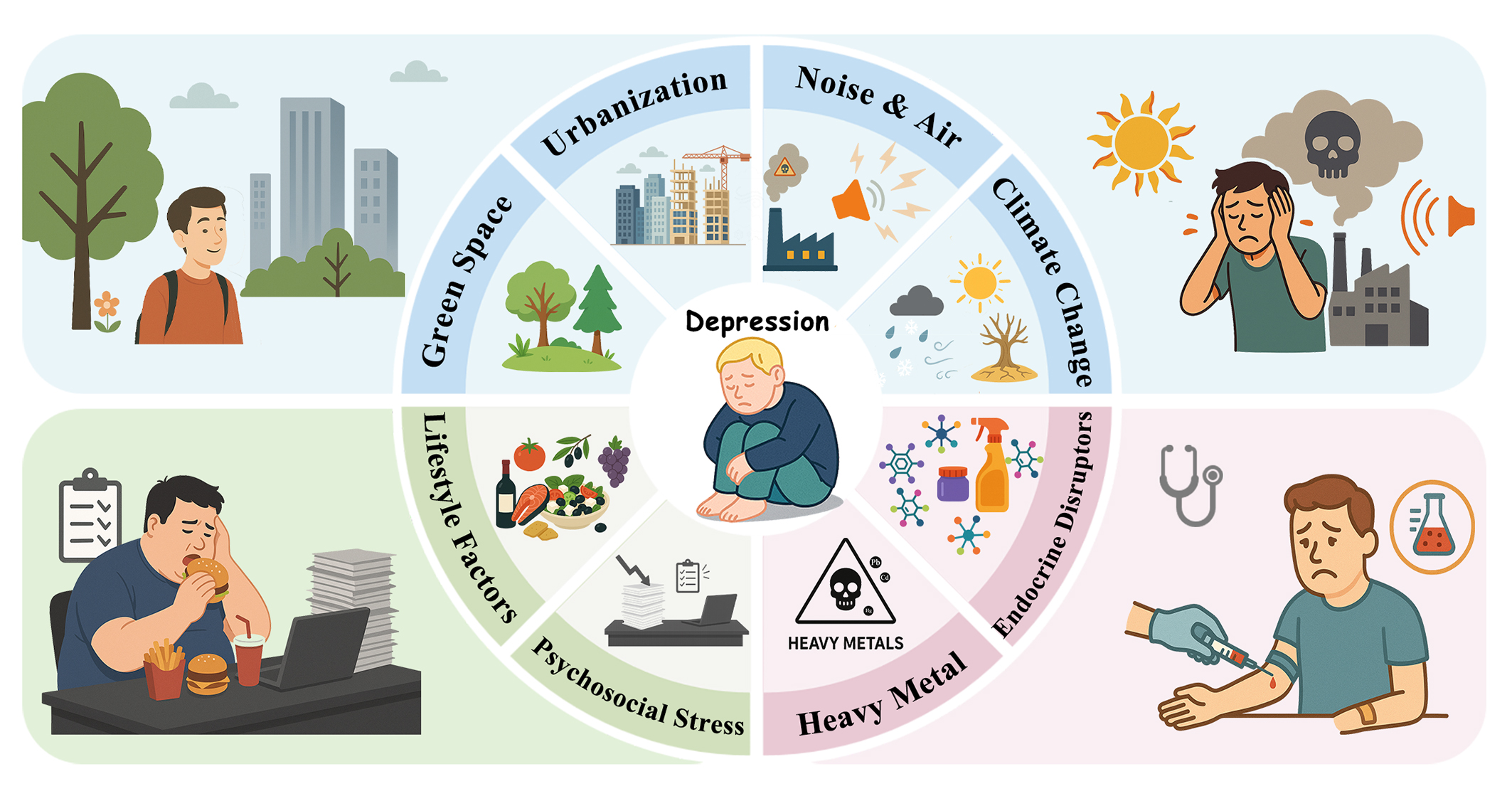
General external exposures encompass macro-environmental factors that exist largely independently of individual behaviors. Among these, air pollution represents one of the most extensively studied exposures. Ambient concentrations of particulate matter (PM2.5 and PM10), nitrogen dioxide (NO2), ozone (O3), and other pollutants have been consistently linked to adverse physical and mental health outcomes, including an elevated risk of depression [25,26] . Another critical general exposure is green space availability. Residential proximity to vegetation, often quantified using indices such as the normalized difference vegetation index (NDVI), has been associated with a range of mental health benefits, including reduced depressive symptomatology [13,27] . Urbanization, characterized by population density, land use patterns, infrastructure development, and transportation systems [28] , is a key factor influencing mental health through mechanisms involving increased social stress, elevated pollutant exposure, and limited access to natural environments [29-31] . At the same time, urban living may offer mental health advantages in some settings by facilitating access to healthcare, education, and economic opportunities, especially in underserved rural areas [32] . This dual role underscores the importance of contextual and population-specific factors in understanding the mental health implications of urbanization. Furthermore, broader climate-related factors, such as exposure to extreme temperatures [33,34] and natural disasters [35] , have emerged as additional environmental stressors with potential mental health implications.
Specific external exposures refer to individualized environmental experiences, often shaped by personal lifestyle choices and psychosocial conditions [9] . Lifestyle factors, such as diet quality, physical activity levels, smoking behavior, alcohol consumption, and quality of sleep, play a critical role in modulating mental health risks. For example, a healthier overall lifestyle [36] , adherence to healthy dietary patterns like the Mediterranean diet [37] and engagement in regular physical activity [38] have been associated with lower prevalence of depression, while unhealthy behaviors, including tobacco use [39] , excessive alcohol intake [40] , sedentary lifestyles [41] , and poor dietary practices, have been linked to increased depression risk. In addition to lifestyle factors, psychosocial stressors such as chronic occupational stress [42] , interpersonal conflicts [43] , financial hardship [44] , social isolation [45] , and exposure to violence [46] have been associated with increased risk of depressive outcomes [47] . Early life adversity, encompassing childhood maltreatment, neglect, and familial dysfunction, is particularly impactful, exerting long-lasting effects on neurodevelopment and stress response systems, thereby increasing vulnerability to depression across the life span [48] .
Internal exposures involve biological changes within the body that either originate from or are influenced by external environmental factors [9] . Heavy metal accumulation, such as lead, cadmium, mercury, and arsenic, constitutes a well-established internal exposure associated with neurodevelopmental disruption and mood disorders [49] . Environmental endocrine-disrupting chemicals such as bisphenol A (BPA) and phthalates have also been implicated in cognitive and emotional dysfunction [50,51] . Additionally, chronic low-grade systemic inflammation and elevated oxidative stress levels represent internal biological states that mediate the relationship between external exposures and depression risk [21] . These internal environment alterations are increasingly recognized as integral components of the exposome, serving as critical links between environmental insults and neuropsychiatric outcomes. Understanding these categories of environmental exposures is essential for disentangling the interconnected factors contributing to depression.
Evidence Linking Exposures to Depression
Air Pollution
Air pollution is among the most extensively investigated environmental exposures in relation to depression. Numerous epidemiological studies have demonstrated significant associations between long-term exposure to particulate matter (PM2.5, PM10) and depressive symptoms, as well as clinical depression diagnoses [52] . A meta-analysis by Braithwaite et al. reported that each 10 μg/m³ increase in PM2.5 concentration was associated with a small but significant increase in depression risk [53] . Other studies, including large-scale cohort analyses conducted in Europe and North America, have consistently shown that exposure to elevated levels of PM2.5, NO2, and traffic-related pollutants correlates with higher depression incidence and severity [54,55] . Importantly, longitudinal designs have provided evidence suggesting that exposure precedes the onset of depressive symptoms, lending support to a possible causal relationship [56] . In addition to long-term exposure effects, short-term fluctuations in air pollution levels have also been linked to acute exacerbations of depressive symptoms. Time-series analyses indicate that increases in PM10 concentrations over a few days are associated with heightened hospital admissions for depressive episodes [57] . Furthermore, there is emerging evidence that prenatal and early life exposure to air pollution may predispose individuals to depression later in life, potentially through mechanisms involving neuroinflammation and altered brain development [58,59] .
Green Space
Residential access to green spaces has been associated with improved mental health outcomes, including lower rates of depression [13] . Multiple cross-sectional and longitudinal studies have demonstrated that greater exposure to green environments is linked to reduced depressive symptomatology, independent of socioeconomic status and urbanicity [60,61] . A meta-analysis suggests that a 10% increase in green space coverage near residential areas is associated with an approximate 3.7% reduction in depression risk [62] . Several plausible mechanisms have been proposed to explain these associations, including stress reduction, enhancement of physical activity, social cohesion promotion, and mitigation of air and noise pollution [63] . Recent research has refined these findings by considering the quality, accessibility, and type of green spaces. For example, individuals with better access to public green spaces tend to exhibit a lower incidence of depressive symptoms, suggesting that not only the amount but also the accessibility of green environments may play a critical role in shaping mental health outcomes [64] . Moreover, longitudinal studies suggest that increases in green space exposure over time correspond to decreases in depression prevalence, supporting a potential protective causal role [65] . Although potential confounding cannot be entirely ruled out, the consistent associations observed across diverse populations provide strong support for promoting green environments as a public health strategy to reduce depression risk.
Noise Exposure
Exposure to environmental noise, particularly from traffic, industrial, and urban sources, has been increasingly investigated as a risk factor for depression [66] . Noise pollution is proposed to exert psychological effects through chronic annoyance, sleep disturbances, and heightened physiological stress responses, such as sustained activation of the hypothalamic-pituitary-adrenal (HPA) axis [67] . Epidemiological studies have found that noise levels in residential environments are closely associated with the onset and progression of depression. For example, one cross-sectional observational study demonstrated that higher residential noise levels correlated with increased depressive symptoms and a greater use of antidepressant medications [68] . Similarly, a large European cohort study reported that individuals exposed to high average day-evening-night noise levels (Lden > 55 dB) had significantly higher risks of experiencing depressive symptoms compared to those living in quieter areas [69] . Furthermore, even after adjusting for potential confounders such as socioeconomic status, road traffic noise exposure remained significantly associated with increased depression risk [70] . Although results have varied somewhat between studies due to differences in noise measurement techniques, exposure assessment windows, and confounder adjustment, the cumulative evidence points toward a modest but meaningful relationship between chronic noise exposure and depression risk, supporting the inclusion of noise mitigation strategies in mental health promotion efforts.
Climate Change
Climate change has increasingly been recognized as an important environmental factor influencing mental health. Rising global temperatures, prolonged heatwaves, droughts, floods, and extreme weather events such as hurricanes have been associated with adverse psychological outcomes, including depression, anxiety, post-traumatic stress disorder, and suicidal behavior [71-74] . Epidemiological studies have demonstrated that individuals exposed to climate change-related disasters—such as floods, hurricanes, and wildfires—experience sustained increases in depressive symptoms, often due to trauma-related factors including loss of loved ones, displacement, property destruction, and community disruption [75-76] . These mental health effects can persist for months or even years after the event [77] . Experimental research suggests that heat exposure can trigger systemic inflammatory responses, including elevated levels of pro-inflammatory cytokines, which may subsequently contribute to neuroinflammation—a potential biological pathway linking environmental heat stress to mood [78,79] . Furthermore, the indirect impacts of climate change—such as economic instability, forced migration, food insecurity, and loss of social cohesion—may exacerbate vulnerability to depression, particularly among socioeconomically disadvantaged populations [80] . Importantly, there are pronounced regional disparities in both the exposure to climate hazards and the capacity to respond. Low- and middle-income countries, as well as marginalized communities within high-income nations, often face a disproportionate burden of climate-related mental health risks due to higher environmental vulnerability, reduced adaptive capacity, and limited access to healthcare and psychosocial support services [81,82] . Although research specifically addressing the link between climate-related exposures and depression is still emerging, accumulating evidence underscores the need to consider climate change as a critical factor in mental health risk assessments. Future investigations should aim to clarify causal pathways and identify effective resilience-promoting strategies to mitigate the psychological impacts of a changing climate.
Urbanization and Built Environment
Urban living has been associated with both increased and decreased risks of depression, depending on contextual factors. Some studies report higher depression prevalence among urban residents compared to rural counterparts, attributed to factors such as higher social stress, environmental pollution, reduced green space, and greater social isolation [83] . Conversely, other research, particularly from developing countries, suggests that urbanization can confer mental health benefits through better healthcare access, education, and employment opportunities [32] . Thus, the relationship between urbanicity and depression is complex and likely moderated by socioeconomic, cultural, and infrastructural variables [84] . Within urban environments, specific neighborhood characteristics—such as overcrowding, poor housing quality, and perceived insecurity—have been consistently linked to higher depressive symptoms [85-87] . These findings suggest that while urbanization introduces structural and social challenges that may heighten depression risk, it is the quality of the built and social environments that ultimately shapes mental health outcomes in urban settings.
Indoor Environmental Quality
In addition to major environmental exposures such as air pollution, noise, green space availability, climate-related events, and urbanization, emerging research has identified other factors that may influence depression risk. Among these, indoor environmental quality has attracted increasing attention, especially given that individuals typically spend approximately 80% to 90% of their time indoors in modern urban lifestyles. Indoor environmental quality, in particular, has attracted increasing attention, especially given that individuals typically spend approximately 80% to 90% of their time indoors in modern urban lifestyles [88] . Studies suggest that indoor environments, particularly poorly ventilated spaces, older buildings, or densely populated urban areas, can accumulate higher concentrations of pollutants compared to outdoor settings. Key pollutants include volatile organic compounds (VOCs) emitted from household products, building materials, and furnishings, as well as combustion by-products from cooking and heating. Prolonged exposure to these indoor pollutants—especially under inadequate ventilation—has been associated with neurological and psychological disturbances, including increased risk of mood disorders and depressive symptoms [89-91] . Moreover, factors such as indoor humidity and exposure to mold and dampness have been consistently associated with increased psychological distress, anxiety, and depression [92,93] . Mold exposure may contribute to neuropsychiatric symptoms through inflammatory, allergic, and immune-mediated mechanisms [94] . Although the evidence base for indoor exposures remains less extensive compared to outdoor factors, accumulating findings highlight the necessity of adopting a comprehensive perspective that integrates both indoor and outdoor environmental influences when assessing the ecological determinants of depression risk.
Lifestyle Factors
Lifestyle behaviors and psychosocial stressors represent critical modifiable domains influencing depression risk. Growing evidence suggests that unhealthy lifestyle patterns significantly are linked to the development and persistence of depressive symptoms. Diet quality, for example, has emerged as an important factor, with studies showing that adherence to healthy eating patterns such as the Mediterranean diet—rich in fruits, vegetables, whole grains, fish, and healthy fats—is associated with reduced depression risk [16,95] , whereas high consumption of processed foods, sugary snacks, and fast food, typical of Western dietary patterns, has been linked to increased depressive symptoms [96] . A prospective cohort study in Australia demonstrated that individuals with higher intake of processed foods had a greater risk of developing depression compared to those adhering to healthier diets [97] . Physical inactivity also predicts greater depression risk, with meta-analytic evidence suggesting that even moderate levels of regular exercise, such as brisk walking for 30 minutes several times a week, can provide significant protective effects [17] .
Psychosocial Stress and Early Life Adversity
Psychosocial stress and early life adversity represent critical specific external exposures that significantly influence depression vulnerability across the lifespan. Chronic occupational stress, economic hardship, social isolation, experiences of discrimination, and exposure to violence have all been consistently associated with heightened depression risk [42,45] . Early life adversity, including childhood abuse, neglect, and family dysfunction, exerts particularly profound and lasting effects [48] , as meta-analytic studies indicate that individuals exposed to adverse childhood experiences have a two- to three-fold increased risk of developing depression in adulthood [98] . These cumulative and enduring impacts of psychosocial stress highlight the necessity of considering both lifestyle factors and environmental contexts when assessing depression risk and developing targeted prevention strategies.
Heavy Metals and Endocrine Disrupting Chemicals
Heavy metals and endocrine-disrupting chemicals represent one major class of internal exposures that have been implicated in depression risk. Heavy metal accumulation, particularly of lead, cadmium, mercury, and arsenic, has been associated with depressive symptoms and clinical depression diagnoses in epidemiological studies [49] . Similarly, exposure to endocrine-disrupting chemicals such as BPA and phthalates may interfere with hormonal signaling pathways relevant to mood regulation [50] . These toxicants may disrupt neurodevelopment and endocrine homeostasis, contributing to mood dysregulation [99] .
Systemic Inflammation and Oxidative Stress
Systemic inflammation and oxidative stress are two core endogenous processes representing internal exposures linked to depression. Chronic low-grade systemic inflammation, reflected by elevated circulating levels of pro-inflammatory cytokines, has been consistently linked to depression in both observational and experimental research [100] . Oxidative stress, characterized by an imbalance between reactive oxygen species production and antioxidant defenses, is another biological state that may mediate environmental effects on brain function and emotional regulation [101] . Relevant biomarkers such as interleukin-6 (IL-6), tumor necrosis factor-alpha (TNF-α), and malondialdehyde (MDA) have been frequently reported in depression-related studies [102,103] .
Gut Microbiota Dysbiosis
Gut microbiota dysbiosis represents another key internal exposure pathway in depression research. Alterations in the gut microbiota—the complex community of microorganisms residing in the gastrointestinal tract—have emerged as potential contributors to depression through immune, metabolic, and neural pathways [24] . Microbial imbalance may influence central nervous system function by modulating systemic inflammation, gut barrier integrity, and neurotransmitter metabolism [104] . While the specific biological pathways connecting these internal exposures to depressive outcomes remain under active investigation, proposed mechanisms include immune system dysregulation, oxidative damage, endocrine disruption, blood-brain barrier compromise, and gut-brain axis alterations.
Potential Mechanisms Linking Environmental Exposures to Depression
While substantial epidemiological evidence supports associations between various environmental exposures and depression, understanding the underlying biological mechanisms is essential to establish causal pathways and to inform prevention and intervention strategies. In the following section, we review major biological pathways through which environmental exposures may influence depression risk, focusing on inflammation, oxidative stress, neuroendocrine dysregulation, blood-brain barrier dysfunction, and gut-brain axis alterations. These mechanisms and their associated environmental triggers, as well as neurobiological impacts are summarized in Table 1.
Table 1. Biological mechanisms linking environmental exposures to depression.
|
Biological mechanism |
Key pathways |
Major environmental triggers |
Impact on brain and mood |
Supporting evidence |
|
Chronic inflammation |
Elevated pro-inflammatory cytokines; Altered neurotransmitter metabolism and synaptic plasticity; Kynurenine pathway activation |
Air pollution; Psychosocial stress; Unhealthy lifestyle |
Neuroinflammation; Impaired neurogenesis; Disrupted synaptic function; Reduced serotonin availability |
Elevated inflammatory markers in depression |
|
Oxidative stress |
Increased reactive oxygen species; Impaired antioxidant defenses; Mitochondrial dysfunction |
Particulate matter; Heavy metals |
Neurotransmission disruption; Neuronal apoptosis; Amplification of inflammation |
Consistently elevated oxidative damage markers in depression; Antioxidant therapies show potential efficacy |
|
Neuroendocrine dysregulation |
Hyperactivation of the hypothalamic-pituitary-adrenal axis; Prolonged cortisol elevation; Impaired glucocorticoid feedback |
Psychosocial adversity; Endocrine-disrupting chemicals |
Hippocampal damage; Emotional dysregulation; Abnormal cortisol rhythms |
Altered diurnal cortisol patterns in depression |
|
Blood-brain barrier dysfunction |
Increased blood-brain barrier permeability; Infiltration of peripheral immune factors and toxins |
Air pollution; Systemic inflammation |
Microglial activation; Neuroinflammation; Neuronal injury |
Animal studies show blood-brain barrier disruption following pollution exposure leads to depression-like behaviors |
|
Gut-brain axis alterations |
Gut microbiota dysbiosis; Altered neurotransmitter production; Inflammatory and neural signaling changes |
Poor diet; Pollutants; Chronic stress |
Mood regulation disturbance; Increased inflammation; Impaired brain signaling |
Fecal microbiota transplantation from depressed individuals induces depressive-like behaviors in animal models |
Chronic Inflammation
One of the most consistently supported mechanisms involves chronic low-grade inflammation. Numerous studies have demonstrated that individuals with depression exhibit elevated levels of pro-inflammatory cytokines, such as IL-6 and TNF-α [105] . Environmental exposures, particularly air pollution, psychosocial stress, and unhealthy lifestyle factors, can trigger systemic inflammatory responses that extend to the brain, leading to neuroinflammation [106] . Pro-inflammatory cytokines can cross the blood-brain barrier or communicate via neural pathways, subsequently altering neurotransmitter metabolism, impairing neurogenesis, and disrupting synaptic plasticity [107] . Moreover, inflammation-induced activation of the kynurenine pathway reduces serotonin bioavailability and increases production of neurotoxic metabolites, thereby contributing to depressive symptomatology [108] . Inflammation often acts synergistically with other pathological processes, including oxidative stress, creating a self-perpetuating cycle of neuronal dysfunction.
Oxidative Stress
Oxidative stress, characterized by an imbalance between the production of reactive oxygen species (ROS) and the body’s antioxidant defense systems, represents another critical biological mechanism linking environmental exposures to depression [109] . Pollutants such as particulate matter and heavy metals can induce oxidative damage to lipids, proteins, and nucleic acids, thereby compromising cellular integrity [110] . In the brain, oxidative stress disrupts mitochondrial function, impairs neurotransmission, and promotes neuronal apoptosis [111] . Individuals with depression often exhibit elevated oxidative stress markers, and antioxidant-based interventions have shown promise in reducing depressive symptoms [21,112] . Importantly, oxidative stress and inflammation are closely intertwined, often amplifying each other’s detrimental effects on brain function [101] .
Neuroendocrine Dysregulation
The HPA axis, the body’s central stress response system, plays a pivotal role in mood regulation [113] . Chronic exposure to environmental stressors, such as psychosocial adversity and endocrine-disrupting chemicals like BPA, can dysregulate the HPA axis. Prolonged activation leads to sustained cortisol secretion, which, when excessive or dysregulated, damages hippocampal neurons, impairs negative feedback mechanisms, and promotes emotional disturbances [114] . Alterations in cortisol patterns, such as a flattened diurnal slope or elevated evening cortisol levels, are commonly observed in individuals with depression [115] . Additionally, endocrine disruptors may interfere with glucocorticoid receptor sensitivity and broader hormonal signaling, exacerbating stress vulnerability and mood dysregulation [116] .
Blood-Brain Barrier Dysfunction
The blood-brain barrier is essential for maintaining brain homeostasis by regulating the passage of molecules between the circulatory system and neural tissue [117] . Environmental insults, notably air pollution and systemic inflammation, have been shown to compromise blood-brain barrier integrity, leading to increased permeability. A disrupted blood-brain barrier permits the infiltration of peripheral immune mediators, toxins, and pathogens into the brain parenchyma, amplifying neuroinflammation and neuronal injury [118] . Animal studies demonstrate that exposure to particulate matter increases blood-brain barrier permeability, activates microglia, and induces depressive-like behaviors, supporting a mechanistic link between environmental exposures, barrier dysfunction, and mood disorders [119,120] .
Gut-Brain Axis Alterations
The gut-brain axis, a complex bidirectional communication system between the gastrointestinal tract and the central nervous system, has emerged as a key player in depression pathophysiology [121] . Environmental exposures, including poor diet quality, pollutants, and chronic stress, can disrupt the gut microbiota, leading to dysbiosis. Microbial imbalance can promote systemic inflammation, alter the production of neurotransmitters such as serotonin, and influence neural signaling pathways critical for mood regulation [122] . Evidence has shown that fecal microbiota transplantation can alleviate depressive symptoms; conversely, transferring gut microbiota from individuals with depression to healthy recipients may induce depression-related symptoms, suggesting bidirectional regulatory potential of the gut microbiota in the development of depression [123] . Consequently, the gut-brain axis offers a promising target for understanding how environmental exposures are biologically embedded and translated into mental health outcomes.
Collectively, these interconnected biological mechanisms highlight the complex ways in which environmental exposures can influence brain structure and function, ultimately increasing vulnerability to depression. Moreover, the interplay between inflammation, oxidative stress, neuroendocrine alterations, barrier dysfunction, and gut dysbiosis suggests that interventions targeting multiple pathways simultaneously may be particularly effective for mitigating the mental health consequences of environmental adversity [124] .
Methodological Challenges
Studying the relationship between environmental exposures and depression presents several methodological challenges that must be carefully addressed to ensure valid and reliable findings. A major concern lies in exposure assessment. General external exposures, such as air pollution and green space availability, are commonly estimated using geographic information system (GIS)-based models, satellite imagery, or land-use regression approaches [125,126] . While practical for large populations, these methods may introduce exposure misclassification by relying on residential address proxies without accounting for individual mobility patterns, occupational exposures, or indoor environments. Personal exposure monitoring using wearable sensors and real-time environmental trackers represents a promising advancement by offering individualized exposure profiles; however, their application remains constrained by high costs, participant burden, and logistical complexity in large epidemiological studies. For specific external exposures like lifestyle behaviors and psychosocial stressors, self-reported questionnaires are widely used due to feasibility and cost-effectiveness, but these instruments are susceptible to recall bias, reporting bias, and social desirability effects [127] . Internal exposures, such as heavy metal concentrations and biomarkers of inflammation or oxidative stress, are typically assessed through biological specimens like blood, urine, hair, or nails, providing objective measurements of internal dose. Nevertheless, many biomarkers reflect only recent or acute exposures unless cumulative markers are employed [128] . A summary of key methods, advantages, and limitations in exposure assessment is presented in Table 2.
Table 2. Methodological considerations in research on environmental determinants of depression
|
Methodological aspect |
Common methods |
Advantages |
Limitations |
|
Exposure assessment |
GIS-based models; Satellite imagery; Land-use regression; Personal monitoring; Self-reports; Biological specimens |
Feasible for large populations; Individualized data via wearables; Objective internal exposure via biomarkers |
Exposure misclassification; High costs; Participant burden; Logistical complexity for wearables; Recall/reporting bias and social desirability effects in self-reports; Short-term biomarkers |
|
Depression outcome measurement |
Self-report scales; Clinical diagnosis; Administrative data |
Efficient for population screening; Clinical data offers diagnostic validity |
Not equivalent to clinical diagnosis and cultural/stigma influences for self-report; Misses subthreshold/untreated cases for administrative health data |
|
Analytic strategies |
Multivariable regression; Time-series (DLNM); Sensitive period analysis; Longitudinal modeling |
Adjusts for confounders; Model dynamic exposure effects; Captures critical periods |
Residual confounding; Complexity of time-varying modeling |
|
Multi-exposure modeling |
WQS regression; BKMR; ExWAS; Machine learning |
Captures joint exposure effects; Handles high-dimensional, nonlinear data |
Limited causal inference; Risk of overfitting |
|
Causal inference approaches |
Instrumental variable analysis; Natural experiments; Propensity scores; Longitudinal mediation analyses mediation analysis; Mendelian randomization |
Enhances causal interpretation; Reduces confounding; Triangulates evidence |
No single method definitive; Requires consistency across methods/populations |
Abbreviations: BKMR, Bayesian kernel machine regression; DLNM, distributed lag non-linear models; ExWAS, exposome-wide association studies; GIS, geographic information system; WQS, weighted quantile sum.
Depression outcome measurement also varies considerably across studies, introducing additional heterogeneity. Many investigations rely on validated self-report screening tools, such as the Patient Health Questionnaire (PHQ-9) or the Center for Epidemiologic Studies Depression Scale (CES-D), to identify depressive symptoms at the population level. While practical for large-scale epidemiological research, these scales are not equivalent to clinical diagnoses based on standardized criteria such as the Diagnostic and Statistical Manual of Mental Disorders (DSM) or the International Classification of Diseases (ICD) [129,130] . Moreover, self-reported symptom scales may be affected by factors such as recall bias and social desirability bias [131,132] . Administrative health data, including antidepressant prescriptions, mental health service utilization, and hospitalization records, provide clinically meaningful endpoints [133] but may under-capture subthreshold depressive symptoms and untreated individuals. Such disparities in outcome definitions complicate cross-study comparisons, meta-analyses, and generalization to broader populations.
Beyond outcome measurement, analytic strategies further shape study findings. Traditional multivariable regression models adjusting for demographic and socioeconomic covariates remain foundational, yet residual confounding from unmeasured variables—such as genetic susceptibility, early life adversity, or personality traits—poses a persistent threat to internal validity [134] . Alternative strategies, such as sibling comparison designs and negative control exposures, may help further mitigate residual confounding in observational settings. Moreover, because environmental exposures and depressive symptoms often evolve dynamically over time, it is increasingly recognized that analyses must adequately capture temporal variability and exposure trajectories. Advanced time-series approaches such as distributed lag non-linear models (DLNM) are therefore utilized to characterize both delayed and cumulative exposure effects [135] . Sensitive period analyses, particularly during critical developmental windows such as prenatal stages or adolescence, also provide valuable insights into periods of heightened vulnerability. These stages are marked by rapid maturation of neuroendocrine systems, stress response pathways, and brain circuits—rendering them especially susceptible to external exposures. Accordingly, longitudinal study designs, time-varying covariate modeling, and repeated measures analysis have become essential methodological components for accurately capturing temporal patterns and elucidating causal relationships.
Finally, recent methodological developments increasingly recognize that individuals are simultaneously exposed to complex mixtures of environmental factors, necessitating analytical approaches that move beyond single-exposure models. Methods such as weighted quantile sum (WQS) regression [136] , Bayesian kernel machine regression (BKMR) [137] , and exposome-wide association studies (ExWAS) [138] allow researchers to assess the joint effects and potential interactions of multiple exposures in a more ecologically valid manner, although challenges remain in handling highly correlated variables, selecting relevant contributors, and interpreting complex models. Machine learning algorithms, including random forests [139] , elastic net regression [140] , and gradient boosting machines [141] , offer powerful tools for handling high-dimensional data, modeling non-linear relationships, and uncovering previously unrecognized exposure-outcome patterns. However, machine learning models often emphasize prediction performance rather than causal inference and require careful validation to avoid overfitting. Establishing causality in observational research remains inherently challenging. Techniques such as instrumental variable analysis [142] , natural experiments exploiting exogenous variation [143] , propensity score methods [144] , and longitudinal mediation analyses [145] are increasingly employed to strengthen causal interpretations. Integrating genetic data through Mendelian randomization further enables triangulation of evidence by reducing confounding and reverse causality concerns [146] . Nevertheless, no single methodological approach is definitive, and consistent findings across diverse study designs, analytic strategies, and populations—through triangulation—remain essential for building robust, credible evidence on environmental determinants of depression.
Future Directions
Advancing research on the environmental determinants of depression requires a shift toward more integrative, temporally sensitive, and inclusive approaches. Central to this transition is the adoption of the exposome framework, which enables comprehensive characterization of the dynamic, cumulative, and multifactorial nature of environmental exposures across the life course. To improve exposure precision, future studies should incorporate high-resolution environmental monitoring technologies, including wearable sensors, remote sensing platforms, and biospecimen-based biomarkers. Longitudinal cohort designs with repeated measures of exposures, biological mediators, and depressive outcomes are critical for identifying sensitive developmental windows and elucidating temporal dynamics. In particular, the prenatal period and adolescence represent key developmental windows when brain and stress-regulation systems are especially plastic and susceptible to environmental influences. Focusing on these stages may help clarify long-term pathways linking exposures to depression.
Beyond single-exposure paradigms, it is essential to address complex environmental mixtures and cumulative burden using advanced analytical strategies such as mixture modeling. At the same time, increasing the inclusion of racially, ethnically, and socioeconomically diverse populations will enhance the generalizability and equity of findings, particularly given that most current evidence comes from high-income and relatively homogenous cohorts, underscoring the need for more inclusive research in low-income and underserved settings. Integrating genetic, epigenetic, and other multi-omics data with environmental exposure assessments will deepen our understanding of gene–environment interactions and biological embedding processes, potentially uncovering biomarkers for early detection and intervention.
Importantly, translating epidemiological insights into actionable public health strategies and policy recommendations remains a major priority. Research should inform interventions and guidelines aimed at reducing harmful environmental exposures, enhancing urban green infrastructure, improving indoor air quality, promoting healthy lifestyle behaviors, and fostering psychosocial resilience. These findings can support the development of evidence-based policies related to environmental regulation, urban design, and preventive mental health care. Policy-relevant studies, including natural experiments and intervention trials, will be essential to evaluate the real-world effectiveness of environmental modifications. Moving forward, interdisciplinary collaboration among environmental scientists, mental health researchers, urban planners, and policymakers will be crucial for designing and implementing scalable, equitable solutions that embed environmental health into mental health promotion and depression prevention efforts.
Conclusion
Depression arises from a complex interplay between genetic vulnerability and environmental exposures across the life span. Robust evidence shows that air pollution, limited access to green space, chronic noise, internal toxicant burdens, and certain aspects of urbanization are associated with increased depression risk. These exposures influence neurobiological and psychological processes through pathways such as inflammation, oxidative stress, hypothalamic-pituitary-adrenal axis dysregulation, blood-brain barrier disruption, and gut-brain axis alterations. Continued efforts to capture exposure complexity, integrate biological data, and address population diversity are essential. Embedding environmental perspectives into mental health research and policy offers valuable opportunities to reduce the burden of depression and promote long-term population resilience. Future efforts should aim to translate scientific findings into evidence-informed public health initiatives and environmental policies that support mental health across diverse populations.
Declarations
Author contributions
Z.Z. contributed to literature review, manuscript writing, and re-vision. Q.Z. contributed to literature review, manuscript writing, and revision. J.X. contributed to literature review, manuscript writing, and revision. K.Y. contributed to literature review and manuscript revision. Y.W. (Yue Wu) contributed to literature review. M.L. contributed to literature review. Q.W. contributed to literature review. H.W. contributed to literature review. W.C. contributed to literature review. Q.A. contributed to literature review. Y.Z. contributed to literature review. Y.W. (Yajing Wang) contributed to literature review. C.L. contributed to conceptual-ization, supervision, manuscript writing, and revision. L.G. con-tributed to conceptualization, supervision, manuscript writing, and revision. F.L. contributed to conceptualization, supervision, manuscript writing, and revision.
Acknowledgements
Not applicable.
Ethics approval and consent to participate
Not applicable.
Funding information
This work was supported by the Tianjin Health Research Project (TJWJ2025MS001), the Tianjin Natural Science Foundation (23JCZXJC00120), and the Tianjin Major Special Project on Public Health Science and Technology (24ZXGQSY00060).
Competing Interests
The authors declare that they have no existing or potential commercial or financial relationships that could create a conflict of interest at the time of conducting this study.
Data Availability
All data needed to evaluate the conclusions in the paper are present in the paper or the Supplementary Materials. Additional data related to this paper may be requested from the authors.
References
[1] Cui L, Li S, Wang S, Wu X, Liu Y, Yu W, et al. (2024). Major depressive disorder: hypothesis, mechanism, prevention and treatment. Signal Transduct Target Ther, 9(1), 30. https://doi.org/10.1038/s41392-024-01738-y
[2] Major Depressive Disorder Working Group of the Psychiatric Genomics Consortium. (2025). Trans-ancestry genome-wide study of depression identifies 697 associations implicating cell types and pharmacotherapies. Cell, 188(3), 640-652.e649. https://doi.org/10.1016/j.cell.2024.12.002
[3] Lynch CJ, Elbau IG, Ng T, Ayaz A, Zhu S, Wolk D, et al. (2024). Frontostriatal salience network expansion in individuals in depression. Nature, 633(8030), 624-633. https://doi.org/10.1038/s41586-024-07805-2
[4] Gotlib IH, & Joormann J. (2010). Cognition and depression: current status and future directions. Annu Rev Clin Psychol, 6, 285-312. https://doi.org/10.1146/annurev.clinpsy.121208.131305
[5] Nestler EJ. (2014). Epigenetic mechanisms of depression. JAMA Psychiatry, 71(4), 454-456. https://doi.org/10.1001/jamapsychiatry.2013.4291
[6] van den Bosch M, & Meyer-Lindenberg A. (2019). Environmental Exposures and Depression: Biological Mechanisms and Epidemiological Evidence. Annu Rev Public Health, 40, 239-259. https://doi.org/10.1146/annurev-publhealth-040218-044106
[7] Liu F, Xu J, Guo L, Qin W, Liang M, Schumann G, et al. (2023). Environmental neuroscience linking exposome to brain structure and function underlying cognition and behavior. Mol Psychiatry, 28(1), 17-27. https://doi.org/10.1038/s41380-022-01669-6
[8] Wild CP. (2005). Complementing the genome with an "exposome": the outstanding challenge of environmental exposure measurement in molecular epidemiology. Cancer Epidemiol Biomarkers Prev, 14(8), 1847-1850. https://doi.org/10.1158/1055-9965.Epi-05-0456
[9] Wild CP. (2012). The exposome: from concept to utility. Int J Epidemiol, 41(1), 24-32. https://doi.org/10.1093/ije/dyr236
[10] Choi KW, Stein MB, Nishimi KM, Ge T, Coleman JRI, Chen CY, et al. (2020). An Exposure-Wide and Mendelian Randomization Approach to Identifying Modifiable Factors for the Prevention of Depression. Am J Psychiatry, 177(10), 944-954. https://doi.org/10.1176/appi.ajp.2020.19111158
[11] Wang Z, Zellers S, Whipp AM, Heinonen-Guzejev M, Foraster M, Júlvez J, et al. (2023). The effect of environment on depressive symptoms in late adolescence and early adulthood: an exposome-wide association study and twin modeling. Nat Ment Health, 1(10), 751-760. https://doi.org/10.1038/s44220-023-00124-x
[12] Fan SJ, Heinrich J, Bloom MS, Zhao TY, Shi TX, Feng WR, et al. (2020). Ambient air pollution and depression: A systematic review with meta-analysis up to 2019. Sci Total Environ, 701, 134721. https://doi.org/10.1016/j.scitotenv.2019.134721
[13] Wang J, Ma Y, Tang L, Li D, Xie J, Hu Y, et al. (2024). Long-term exposure to residential greenness and decreased risk of depression and anxiety. Nat Ment Health, 2(5), 525-534. https://doi.org/10.1038/s44220-024-00227-z
[14] Jigeer G, Tao W, Zhu Q, Xu X, Zhao Y, Kan H, et al. (2022). Association of residential noise exposure with maternal anxiety and depression in late pregnancy. Environ Int, 168, 107473. https://doi.org/10.1016/j.envint.2022.107473
[15] Chen TK, Horsdal HT, Samuelsson K, Closter AM, Davies M, Barthel S, et al. (2023). Higher depression risks in medium- than in high-density urban form across Denmark. Sci Adv, 9(21), eadf3760. https://doi.org/10.1126/sciadv.adf3760
[16] Molendijk M, Molero P, Ortuño Sánchez-Pedreño F, Van der Does W, & Angel Martínez-González M. (2018). Diet quality and depression risk: A systematic review and dose-response meta-analysis of prospective studies. J Affect Disord, 226, 346-354. https://doi.org/10.1016/j.jad.2017.09.022
[17] Pearce M, Garcia L, Abbas A, Strain T, Schuch FB, Golubic R, et al. (2022). Association Between Physical Activity and Risk of Depression: A Systematic Review and Meta-analysis. JAMA Psychiatry, 79(6), 550-559. https://doi.org/10.1001/jamapsychiatry.2022.0609
[18] Zhang L, Wang Z, Liu K, Li J, & Li Y. (2024). Investigation of the relationship between heavy metals in the blood and depression in people with different body mass indices using the NHANES database: A cross-sectional study. J Affect Disord, 344, 311-318. https://doi.org/10.1016/j.jad.2023.10.023
[19] Stuart SA, Hinchcliffe JK, & Robinson ESJ. (2019). Evidence that neuropsychological deficits following early life adversity may underlie vulnerability to depression. Neuropsychopharmacology, 44(9), 1623-1630. https://doi.org/10.1038/s41386-019-0388-6
[20] Leonard BE. (2018). Inflammation and depression: a causal or coincidental link to the pathophysiology? Acta Neuropsychiatr, 30(1), 1-16. https://doi.org/10.1017/neu.2016.69
[21] Bhatt S, Nagappa AN, & Patil CR. (2020). Role of oxidative stress in depression. Drug Discov Today, 25(7), 1270-1276. https://doi.org/10.1016/j.drudis.2020.05.001
[22] Kim YK, Na KS, Myint AM, & Leonard BE. (2016). The role of pro-inflammatory cytokines in neuroinflammation, neurogenesis and the neuroendocrine system in major depression. Prog Neuropsychopharmacol Biol Psychiatry, 64, 277-284. https://doi.org/10.1016/j.pnpbp.2015.06.008
[23] Matsuno H, Tsuchimine S, O'Hashi K, Sakai K, Hattori K, Hidese S, et al. (2022). Association between vascular endothelial growth factor-mediated blood-brain barrier dysfunction and stress-induced depression. Mol Psychiatry, 27(9), 3822-3832. https://doi.org/10.1038/s41380-022-01618-3
[24] Schachter J, Martel J, Lin CS, Chang CJ, Wu TR, Lu CC, et al. (2018). Effects of obesity on depression: A role for inflammation and the gut microbiota. Brain Behav Immun, 69, 1-8. https://doi.org/10.1016/j.bbi.2017.08.026
[25] Bhui K, Newbury JB, Latham RM, Ucci M, Nasir ZA, Turner B, et al. (2023). Air quality and mental health: evidence, challenges and future directions. BJPsych Open, 9(4), e120. https://doi.org/10.1192/bjo.2023.507
[26] Ju K, Lu L, Chen T, Duan Z, Chen D, Liao W, et al. (2022). Does long-term exposure to air pollution impair physical and mental health in the middle-aged and older adults? - A causal empirical analysis based on a longitudinal nationwide cohort in China. Sci Total Environ, 827, 154312. https://doi.org/10.1016/j.scitotenv.2022.154312
[27] Xu J, Liu N, Polemiti E, Garcia-Mondragon L, Tang J, Liu X, et al. (2023). Effects of urban living environments on mental health in adults. Nat Med, 29(6), 1456-1467. https://doi.org/10.1038/s41591-023-02365-w
[28] Moll RJ, Cepek JD, Lorch PD, Dennis PM, Tans E, Robison T, et al. (2019). What does urbanization actually mean? A framework for urban metrics in wildlife research. J Appl Ecol, 56(5), 1289-1300. https://doi.org/10.1111/1365-2664.13358
[29] Sampson L, Ettman CK, & Galea S. (2020). Urbanization, urbanicity, and depression: a review of the recent global literature. Curr Opin Psychiatry, 33(3), 233-244. https://doi.org/10.1097/yco.0000000000000588
[30] Galea S, Ahern J, Rudenstine S, Wallace Z, & Vlahov D. (2005). Urban built environment and depression: a multilevel analysis. J Epidemiol Community Health, 59(10), 822-827. https://doi.org/10.1136/jech.2005.033084
[31] Ventriglio A, Torales J, Castaldelli-Maia JM, De Berardis D, & Bhugra D. (2021). Urbanization and emerging mental health issues. CNS Spectr, 26(1), 43-50. https://doi.org/10.1017/s1092852920001236
[32] Hou B, Nazroo J, Banks J, & Marshall A. (2019). Are cities good for health? A study of the impacts of planned urbanization in China. Int J Epidemiol, 48(4), 1083-1090. https://doi.org/10.1093/ije/dyz031
[33] Chen NT, Lin PH, & Guo YL. (2019). Long-term exposure to high temperature associated with the incidence of major depressive disorder. Sci Total Environ, 659, 1016-1020. https://doi.org/10.1016/j.scitotenv.2018.12.434
[34] Jin J, Xu Z, Cao R, Wang Y, Zeng Q, Pan X, et al. (2023). Long-Term Apparent Temperature, Extreme Temperature Exposure, and Depressive Symptoms: A Longitudinal Study in China. Int J Environ Res Public Health, 20(4). https://doi.org/10.3390/ijerph20043229
[35] Tang B, Liu X, Liu Y, Xue C, & Zhang L. (2014). A meta-analysis of risk factors for depression in adults and children after natural disasters. BMC Public Health, 14, 623. https://doi.org/10.1186/1471-2458-14-623
[36] Hautekiet P, Saenen ND, Martens DS, Debay M, Van der Heyden J, Nawrot TS, et al. (2022). A healthy lifestyle is positively associated with mental health and well-being and core markers in ageing. BMC Med, 20(1), 328. https://doi.org/10.1186/s12916-022-02524-9
[37] Yin W, Löf M, Chen R, Hultman CM, Fang F, & Sandin S. (2021). Mediterranean diet and depression: a population-based cohort study. Int J Behav Nutr Phys Act, 18(1), 153. https://doi.org/10.1186/s12966-021-01227-3
[38] Kandola A, Ashdown-Franks G, Hendrikse J, Sabiston CM, & Stubbs B. (2019). Physical activity and depression: Towards understanding the antidepressant mechanisms of physical activity. Neurosci Biobehav Rev, 107, 525-539. https://doi.org/10.1016/j.neubiorev.2019.09.040
[39] Fluharty M, Taylor AE, Grabski M, & Munafò MR. (2017). The Association of Cigarette Smoking With Depression and Anxiety: A Systematic Review. Nicotine Tob Res, 19(1), 3-13. https://doi.org/10.1093/ntr/ntw140
[40] Li J, Wang H, Li M, Shen Q, Li X, Zhang Y, et al. (2020). Effect of alcohol use disorders and alcohol intake on the risk of subsequent depressive symptoms: a systematic review and meta-analysis of cohort studies. Addiction, 115(7), 1224-1243. https://doi.org/10.1111/add.14935
[41] Zhai L, Zhang Y, & Zhang D. (2015). Sedentary behaviour and the risk of depression: a meta-analysis. Br J Sports Med, 49(11), 705-709. https://doi.org/10.1136/bjsports-2014-093613
[42] Magnavita N, & Fileni A. (2014). Association of work-related stress with depression and anxiety in radiologists. Radiol Med, 119(5), 359-366. https://doi.org/10.1007/s11547-013-0355-y
[43] Hammen C. (2018). Risk Factors for Depression: An Autobiographical Review. Annu Rev Clin Psychol, 14, 1-28. https://doi.org/10.1146/annurev-clinpsy-050817-084811
[44] Frankham C, Richardson T, & Maguire N. (2020). Psychological factors associated with financial hardship and mental health: A systematic review. Clin Psychol Rev, 77, 101832. https://doi.org/10.1016/j.cpr.2020.101832
[45] Qi X, Cheng S, Yang J, Liu L, Hao J, Wei W, et al. (2025). The risk of social isolation and loneliness on progression from incident cardiovascular disease to subsequent depression. Nat Ment Health, 10.1038/s44220-025-00418-2, 1-9. https://doi.org/10.1038/s44220-025-00418-2
[46] Stein C, Flor LS, Gil GF, Khalil M, Herbert M, Aravkin AY, et al. (2025). The health effects associated with physical, sexual and psychological gender-based violence against men and women: a Burden of Proof study. Nat Hum Behav, 10.1038/s41562-025-02144-2. https://doi.org/10.1038/s41562-025-02144-2
[47] Mikkelsen S, Coggon D, Andersen JH, Casey P, Flachs EM, Kolstad HA, et al. (2021). Are depressive disorders caused by psychosocial stressors at work? A systematic review with metaanalysis. Eur J Epidemiol, 36(5), 479-496. https://doi.org/10.1007/s10654-021-00725-9
[48] Rao U, Chen LA, Bidesi AS, Shad MU, Thomas MA, & Hammen CL. (2010). Hippocampal changes associated with early-life adversity and vulnerability to depression. Biol Psychiatry, 67(4), 357-364. https://doi.org/10.1016/j.biopsych.2009.10.017
[49] Appleton AA, Jackson BP, Karagas M, & Marsit CJ. (2017). Prenatal exposure to neurotoxic metals is associated with increased placental glucocorticoid receptor DNA methylation. Epigenetics, 12(8), 607-615. https://doi.org/10.1080/15592294.2017.1320637
[50] Kahn LG, Philippat C, Nakayama SF, Slama R, & Trasande L. (2020). Endocrine-disrupting chemicals: implications for human health. Lancet Diabetes Endocrinol, 8(8), 703-718. https://doi.org/10.1016/s2213-8587(20)30129-7
[51] Costa HE, & Cairrao E. (2024). Effect of bisphenol A on the neurological system: a review update. Arch Toxicol, 98(1), 1-73. https://doi.org/10.1007/s00204-023-03614-0
[52] Borroni E, Pesatori AC, Bollati V, Buoli M, & Carugno M. (2022). Air pollution exposure and depression: A comprehensive updated systematic review and meta-analysis. Environ Pollut, 292(Pt A), 118245. https://doi.org/10.1016/j.envpol.2021.118245
[53] Braithwaite I, Zhang S, Kirkbride JB, Osborn DPJ, & Hayes JF. (2019). Air Pollution (Particulate Matter) Exposure and Associations with Depression, Anxiety, Bipolar, Psychosis and Suicide Risk: A Systematic Review and Meta-Analysis. Environ Health Perspect, 127(12), 126002. https://doi.org/10.1289/ehp4595
[54] Yang T, Wang J, Huang J, Kelly FJ, & Li G. (2023). Long-term Exposure to Multiple Ambient Air Pollutants and Association With Incident Depression and Anxiety. JAMA Psychiatry, 80(4), 305-313. https://doi.org/10.1001/jamapsychiatry.2022.4812
[55] Power MC, Kioumourtzoglou MA, Hart JE, Okereke OI, Laden F, & Weisskopf MG. (2015). The relation between past exposure to fine particulate air pollution and prevalent anxiety: observational cohort study. BMJ, 350, h1111. https://doi.org/10.1136/bmj.h1111
[56] Nobile F, Forastiere A, Michelozzi P, Forastiere F, & Stafoggia M. (2023). Long-term exposure to air pollution and incidence of mental disorders. A large longitudinal cohort study of adults within an urban area. Environ Int, 181, 108302. https://doi.org/10.1016/j.envint.2023.108302
[57] Lu P, Zhang Y, Xia G, Zhang W, Xu R, Wang C, et al. (2020). Attributable risks associated with hospital outpatient visits for mental disorders due to air pollution: A multi-city study in China. Environ Int, 143, 105906. https://doi.org/10.1016/j.envint.2020.105906
[58] Latham RM, Kieling C, Arseneault L, Rocha TB-M, Beddows A, Beevers SD, et al. (2021). Childhood exposure to ambient air pollution and predicting individual risk of depression onset in UK adolescents. J Psychiatr Res, 138, 60-67. https://doi.org/10.1016/j.jpsychires.2021.03.042
[59] Jáni M, Mikeš O, Marecek R, Brazdil M, & Mareckova K. (2024). Prenatal exposure to air pollution and maternal depression: Combined effects on brain aging and mental health in young adulthood. Prog Neuropsychopharmacol Biol Psychiatry, 134, 111062. https://doi.org/10.1016/j.pnpbp.2024.111062
[60] Gascon M, Sánchez-Benavides G, Dadvand P, Martínez D, Gramunt N, Gotsens X, et al. (2018). Long-term exposure to residential green and blue spaces and anxiety and depression in adults: A cross-sectional study. Environ Res, 162, 231-239. https://doi.org/10.1016/j.envres.2018.01.012
[61] Astell-Burt T, Mitchell R, & Hartig T. (2014). The association between green space and mental health varies across the lifecourse. A longitudinal study. J Epidemiol Community Health, 68(6), 578-583. https://doi.org/10.1136/jech-2013-203767
[62] Liu Z, Chen X, Cui H, Ma Y, Gao N, Li X, et al. (2023). Green space exposure on depression and anxiety outcomes: A meta-analysis. Environ Res, 231(Pt 3), 116303. https://doi.org/10.1016/j.envres.2023.116303
[63] Yao W, Zhang X, & Gong Q. (2021). The effect of exposure to the natural environment on stress reduction: A meta-analysis. Urban Forestry & Urban Greening, 57, 126932.
[64] Shezi B, Mendoza H, Govindasamy D, Casas L, Balakrishna Y, Bantjes J, et al. (2024). Proximity to public green spaces and depressive symptoms among South African residents: a population-based study. BMC Public Health, 24(1), 925. https://doi.org/10.1186/s12889-024-18385-1
[65] Park H, Kang C, Team A-C, & Kim H. (2024). Association between air pollution (PM10, PM2. 5), greenness and depression in older adults: a longitudinal study in South Korea. Epidemiol Psych Sci, 33, e71. https://doi.org/10.1017/S2045796024000684
[66] Ma J, Li C, Kwan M-P, & Chai Y. (2018). A multilevel analysis of perceived noise pollution, geographic contexts and mental health in Beijing. Int J Environ Res Public Health, 15(7), 1479. https://doi.org/10.3390/ijerph15071479
[67] Hahad O, Kuntic M, Al-Kindi S, Kuntic I, Gilan D, Petrowski K, et al. (2025). Noise and mental health: evidence, mechanisms, and consequences. J Expo Sci Environ Epidemiol, 35(1), 16-23. https://doi.org/10.1038/s41370-024-00642-5
[68] Okokon EO, Yli-Tuomi T, Turunen AW, Tiittanen P, Juutilainen J, & Lanki T. (2018). Traffic noise, noise annoyance and psychotropic medication use. Environ Int, 119, 287-294. https://doi.org/10.1016/j.envint.2018.06.034
[69] Tsimpida D, & Tsakiridi A. (2025). The Relationship between Noise Pollution and Depression and Implications for Healthy Aging: A Spatial Analysis Using Routinely Collected Primary Care Data. J Urban Health, 102(1), 101-112. https://doi.org/10.1007/s11524-024-00945-w
[70] Orban E, McDonald K, Sutcliffe R, Hoffmann B, Fuks KB, Dragano N, et al. (2016). Residential road traffic noise and high depressive symptoms after five years of follow-up: results from the Heinz Nixdorf recall study. Environ Health Perspect, 124(5), 578-585. https://doi.org/10.1289/ehp.1409400
[71] Tong S. (2017). Flooding-related displacement and mental health. Lancet Planet Health, 1(4), e124-e125. https://doi.org/10.1016/s2542-5196(17)30062-1
[72] Fernandez A, Black J, Jones M, Wilson L, Salvador-Carulla L, Astell-Burt T, et al. (2015). Flooding and mental health: a systematic mapping review. PLoS One, 10(4), e0119929. https://doi.org/10.1371/journal.pone.0119929
[73] Thompson R, Hornigold R, Page L, & Waite T. (2018). Associations between high ambient temperatures and heat waves with mental health outcomes: a systematic review. Public Health, 161, 171-191. https://doi.org/10.1016/j.puhe.2018.06.008
[74] Garfin DR, Thompson RR, Holman EA, Wong-Parodi G, & Silver RC. (2022). Association Between Repeated Exposure to Hurricanes and Mental Health in a Representative Sample of Florida Residents. JAMA Netw Open, 5(6), e2217251. https://doi.org/10.1001/jamanetworkopen.2022.17251
[75] French CE, Waite TD, Armstrong B, Rubin GJ, Beck CR, & Oliver I. (2019). Impact of repeat flooding on mental health and health-related quality of life: a cross-sectional analysis of the English National Study of Flooding and Health. BMJ Open, 9(11), e031562. https://doi.org/10.1136/bmjopen-2019-031562
[76] Munro A, Kovats RS, Rubin GJ, Waite TD, Bone A, & Armstrong B. (2017). Effect of evacuation and displacement on the association between flooding and mental health outcomes: a cross-sectional analysis of UK survey data. Lancet Planet Health, 1(4), e134-e141. https://doi.org/10.1016/s2542-5196(17)30047-5
[77] To P, Eboreime E, & Agyapong VIO. (2021). The Impact of Wildfires on Mental Health: A Scoping Review. Behav Sci (Basel), 11(9). https://doi.org/10.3390/bs11090126
[78] Weng H, Deng L, Wang T, Xu H, Wu J, Zhou Q, et al. (2024). Humid heat environment causes anxiety-like disorder via impairing gut microbiota and bile acid metabolism in mice. Nat Commun, 15(1), 5697. https://doi.org/10.1038/s41467-024-49972-w
[79] Chauhan NR, Kapoor M, Prabha Singh L, Gupta RK, Chand Meena R, Tulsawani R, et al. (2017). Heat stress-induced neuroinflammation and aberration in monoamine levels in hypothalamus are associated with temperature dysregulation. Neuroscience, 358, 79-92. https://doi.org/10.1016/j.neuroscience.2017.06.023
[80] White BP, Breakey S, Brown MJ, Smith JR, Tarbet A, Nicholas PK, et al. (2023). Mental Health Impacts of Climate Change Among Vulnerable Populations Globally: An Integrative Review. Ann Glob Health, 89(1), 66. https://doi.org/10.5334/aogh.4105
[81] Hayes K, Blashki G, Wiseman J, Burke S, & Reifels L. (2018). Climate change and mental health: risks, impacts and priority actions. Int J Ment Health Syst, 12, 28. https://doi.org/10.1186/s13033-018-0210-6
[82] Charlson F, Ali S, Benmarhnia T, Pearl M, Massazza A, Augustinavicius J, et al. (2021). Climate change and mental health: a scoping review. International journal of environmental research and public health, 18(9), 4486.
[83] Jeong JA, Kim SA, Yang JH, & Shin MH. (2023). Urban-Rural Differences in the Prevalence of Depressive Symptoms in Korean Adults. Chonnam Med J, 59(2), 128-133. https://doi.org/10.4068/cmj.2023.59.2.128
[84] Xu C, Miao L, Turner D, & DeRubeis R. (2023). Urbanicity and depression: A global meta-analysis. J Affect Disord, 340, 299-311. https://doi.org/10.1016/j.jad.2023.08.030
[85] Pengcheng L, Longfei Z, Shujuan C, & Xiaojie W. (2021). Association between household overcrowding and depressive mood among Chinese residents. J Affect Disord, 290, 74-80. https://doi.org/10.1016/j.jad.2021.04.066
[86] Suglia SF, Duarte CS, & Sandel MT. (2011). Housing quality, housing instability, and maternal mental health. J Urban Health, 88, 1105-1116. https://doi.org/10.1007/s11524-011-9587-0
[87] Keen R, Chen JT, Slopen N, Sandel M, Copeland WE, & Tiemeier H. (2023). Prospective associations of childhood housing insecurity with anxiety and depression symptoms during childhood and adulthood. JAMA pediatrics, 177(8), 818-826. https://doi.org/10.1001/jamapediatrics.2023.1733
[88] Zhao R, Sun S, & Ding R. (2004). Conditioning strategies of indoor thermal environment in warm climates. Energy and buildings, 36(12), 1281-1286.
[89] Zhang X, Ding L, Yang F, Qiao G, Gao X, Xiong Z, et al. (2024). Association between indoor air pollution and depression: a systematic review and meta-analysis of cohort studies. BMJ Open, 14(5), e075105. https://doi.org/10.1136/bmjopen-2023-075105
[90] Torres G, Subbaiah RT, Sood RA, & Leheste JR. (2024). From air to mind: unraveling the impact of indoor pollutants on psychiatric disorders. Front Psychiatry, 15, 1511475. https://doi.org/10.3389/fpsyt.2024.1511475
[91] Tran VV, Park D, & Lee YC. (2020). Indoor Air Pollution, Related Human Diseases, and Recent Trends in the Control and Improvement of Indoor Air Quality. Int J Environ Res Public Health, 17(8). https://doi.org/10.3390/ijerph17082927
[92] Harding CF, Pytte CL, Page KG, Ryberg KJ, Normand E, Remigio GJ, et al. (2020). Mold inhalation causes innate immune activation, neural, cognitive and emotional dysfunction. Brain Behav Immun, 87, 218-228. https://doi.org/10.1016/j.bbi.2019.11.006
[93] Wolkoff P. (2018). Indoor air humidity, air quality, and health - An overview. Int J Hyg Environ Health, 221(3), 376-390. https://doi.org/10.1016/j.ijheh.2018.01.015
[94] Crago BR, Gray MR, Nelson LA, Davis M, Arnold L, & Thrasher JD. (2003). Psychological, neuropsychological, and electrocortical effects of mixed mold exposure. Arch Environ Health, 58(8), 452-463. https://doi.org/10.3200/aeoh.58.8.452-463
[95] Psaltopoulou T, Sergentanis TN, Panagiotakos DB, Sergentanis IN, Kosti R, & Scarmeas N. (2013). Mediterranean diet, stroke, cognitive impairment, and depression: A meta-analysis. Ann Neurol, 74(4), 580-591. https://doi.org/10.1002/ana.23944
[96] Akbaraly TN, Brunner EJ, Ferrie JE, Marmot MG, Kivimaki M, & Singh-Manoux A. (2009). Dietary pattern and depressive symptoms in middle age. Br J Psychiatry, 195(5), 408-413. https://doi.org/10.1192/bjp.bp.108.058925
[97] Lane MM, Lotfaliany M, Hodge AM, O'Neil A, Travica N, Jacka FN, et al. (2023). High ultra-processed food consumption is associated with elevated psychological distress as an indicator of depression in adults from the Melbourne Collaborative Cohort Study. J Affect Disord, 335, 57-66. https://doi.org/10.1016/j.jad.2023.04.124
[98] Chapman DP, Whitfield CL, Felitti VJ, Dube SR, Edwards VJ, & Anda RF. (2004). Adverse childhood experiences and the risk of depressive disorders in adulthood. J Affect Disord, 82(2), 217-225. https://doi.org/10.1016/j.jad.2003.12.013
[99] Mitra P, Sharma S, Purohit P, & Sharma P. (2017). Clinical and molecular aspects of lead toxicity: An update. Crit Rev Clin Lab Sci, 54(7-8), 506-528. https://doi.org/10.1080/10408363.2017.1408562
[100] Poletti S, Mazza MG, & Benedetti F. (2024). Inflammatory mediators in major depression and bipolar disorder. Transl Psychiatry, 14(1), 247. https://doi.org/10.1038/s41398-024-02921-z
[101] Trofin DM, Sardaru DP, Trofin D, Onu I, Tutu A, Onu A, et al. (2025). Oxidative Stress in Brain Function. Antioxidants (Basel), 14(3). https://doi.org/10.3390/antiox14030297
[102] Debnath M, Berk M, & Maes M. (2021). Translational evidence for the Inflammatory Response System (IRS)/Compensatory Immune Response System (CIRS) and neuroprogression theory of major depression. Prog Neuropsychopharmacol Biol Psychiatry, 111, 110343. https://doi.org/10.1016/j.pnpbp.2021.110343
[103] Mac Giollabhui N, Ng TH, Ellman LM, & Alloy LB. (2021). The longitudinal associations of inflammatory biomarkers and depression revisited: systematic review, meta-analysis, and meta-regression. Mol Psychiatry, 26(7), 3302-3314. https://doi.org/10.1038/s41380-020-00867-4
[104] Cryan JF, & Dinan TG. (2012). Mind-altering microorganisms: the impact of the gut microbiota on brain and behaviour. Nat Rev Neurosci, 13(10), 701-712. https://doi.org/10.1038/nrn3346
[105] Dowlati Y, Herrmann N, Swardfager W, Liu H, Sham L, Reim EK, et al. (2010). A meta-analysis of cytokines in major depression. Biol Psychiatry, 67(5), 446-457. https://doi.org/10.1016/j.biopsych.2009.09.033
[106] Thomson EM. (2019). Air Pollution, Stress, and Allostatic Load: Linking Systemic and Central Nervous System Impacts. J Alzheimers Dis, 69(3), 597-614. https://doi.org/10.3233/jad-190015
[107] Khairova RA, Machado-Vieira R, Du J, & Manji HK. (2009). A potential role for pro-inflammatory cytokines in regulating synaptic plasticity in major depressive disorder. Int J Neuropsychopharmacol, 12(4), 561-578. https://doi.org/10.1017/s1461145709009924
[108] Savitz J. (2020). The kynurenine pathway: a finger in every pie. Mol Psychiatry, 25(1), 131-147. https://doi.org/10.1038/s41380-019-0414-4
[109] Correia AS, Cardoso A, & Vale N. (2023). Oxidative Stress in Depression: The Link with the Stress Response, Neuroinflammation, Serotonin, Neurogenesis and Synaptic Plasticity. Antioxidants (Basel), 12(2). https://doi.org/10.3390/antiox12020470
[110] Wāng Y. (2025). Ambient fine particulate matter provokes multiple modalities of cell death via perturbation of subcellular structures. Environ Int, 195, 109193. https://doi.org/10.1016/j.envint.2024.109193
[111] Yan MH, Wang X, & Zhu X. (2013). Mitochondrial defects and oxidative stress in Alzheimer disease and Parkinson disease. Free Radic Biol Med, 62, 90-101. https://doi.org/10.1016/j.freeradbiomed.2012.11.014
[112] Lopresti AL, Maker GL, Hood SD, & Drummond PD. (2014). A review of peripheral biomarkers in major depression: the potential of inflammatory and oxidative stress biomarkers. Prog Neuropsychopharmacol Biol Psychiatry, 48, 102-111. https://doi.org/10.1016/j.pnpbp.2013.09.017
[113] Stetler C, & Miller GE. (2011). Depression and hypothalamic-pituitary-adrenal activation: a quantitative summary of four decades of research. Psychosom Med, 73(2), 114-126. https://doi.org/10.1097/psy.0b013e31820ad12b
[114] Raymond C, Marin MF, Majeur D, & Lupien S. (2018). Early child adversity and psychopathology in adulthood: HPA axis and cognitive dysregulations as potential mechanisms. Prog Neuropsychopharmacol Biol Psychiatry, 85, 152-160. https://doi.org/10.1016/j.pnpbp.2017.07.015
[115] Dienes KA, Hazel NA, & Hammen CL. (2013). Cortisol secretion in depressed, and at-risk adults. Psychoneuroendocrinology, 38(6), 927-940. https://doi.org/10.1016/j.psyneuen.2012.09.019
[116] Guarnotta V, Amodei R, Frasca F, Aversa A, & Giordano C. (2022). Impact of chemical endocrine disruptors and hormone modulators on the endocrine system. Int J Mol. Sci, 23(10), 5710. https://doi.org/10.3390/ijms23105710
[117] Wu D, Chen Q, Chen X, Han F, Chen Z, & Wang Y. (2023). The blood-brain barrier: structure, regulation, and drug delivery. Signal Transduct Target Ther, 8(1), 217. https://doi.org/10.1038/s41392-023-01481-w
[118] Galea I. (2021). The blood–brain barrier in systemic infection and inflammation. Cell Mol Immunol, 18(11), 2489-2501. https://doi.org/10.1038/s41423-021-00757-x
[119] Li H, Guo X, Li P, Gao X, Song X, Chen X, et al. (2024). Particulate matter induces depression-like behavior through systemic inflammation and brain-derived neurotrophic factors. Environ Int, 194, 108883. https://doi.org/10.1016/j.envint.2024.108883
[120] Zhao C, Xie P, Yong T, Huang W, Liu J, Wu D, et al. (2021). Airborne fine particulate matter induces cognitive and emotional disorders in offspring mice exposed during pregnancy. Sci Bull (Beijing), 66(6), 578-591. https://doi.org/10.1016/j.scib.2020.08.036
[121] Foster JA, & Neufeld K-AM. (2013). Gut–brain axis: how the microbiome influences anxiety and depression. Trends Neurosci, 36(5), 305-312. https://doi.org/10.1016/j.tins.2013.01.005
[122] Singh S, Sharma P, Pal N, Kumawat M, Shubham S, Sarma DK, et al. (2022). Impact of Environmental Pollutants on Gut Microbiome and Mental Health via the Gut-Brain Axis. Microorganisms, 10(7). https://doi.org/10.3390/microorganisms10071457
[123] Chinna Meyyappan A, Forth E, Wallace CJK, & Milev R. (2020). Effect of fecal microbiota transplant on symptoms of psychiatric disorders: a systematic review. BMC Psychiatry, 20(1), 299. https://doi.org/10.1186/s12888-020-02654-5
[124] Shandilya S, Kumar S, Kumar Jha N, Kumar Kesari K, & Ruokolainen J. (2022). Interplay of gut microbiota and oxidative stress: Perspective on neurodegeneration and neuroprotection. J Adv Res, 38, 223-244. https://doi.org/10.1016/j.jare.2021.09.005
[125] Tomita A, Vandormael AM, Cuadros D, Di Minin E, Heikinheimo V, Tanser F, et al. (2017). Green environment and incident depression in South Africa: a geospatial analysis and mental health implications in a resource-limited setting. Lancet Planet Health, 1(4), e152-e162. https://doi.org/10.1016/s2542-5196(17)30063-3
[126] Guo Y, Su JG, Dong Y, & Wolch J. (2019). Application of land use regression techniques for urban greening: An analysis of Tianjin, China. Urban Forestry & Urban Greening, 38, 11-21.
[127] Rosenman R, Tennekoon V, & Hill LG. (2011). Measuring bias in self-reported data. Int J Behav Healthc Res, 2(4), 320-332. https://doi.org/10.1504/IJBHR.2011.043414
[128] Ryan PB, Burke TA, Cohen Hubal EA, Cura JJ, & McKone TE. (2007). Using biomarkers to inform cumulative risk assessment. Environ Health Perspect, 115(5), 833-840. https://doi.org/10.1289/ehp.9334
[129] Manea L, Gilbody S, & McMillan D. (2015). A diagnostic meta-analysis of the Patient Health Questionnaire-9 (PHQ-9) algorithm scoring method as a screen for depression. Gen Hosp Psychiatry, 37(1), 67-75. https://doi.org/10.1016/j.genhosppsych.2014.09.009
[130] Vilagut G, Forero CG, Barbaglia G, & Alonso J. (2016). Screening for depression in the general population with the Center for Epidemiologic Studies Depression (CES-D): a systematic review with meta-analysis. PLoS One, 11(5), e0155431. https://doi.org/10.1371/journal.pone.0155431
[131] Adams AS, Soumerai SB, Lomas J, & Ross-Degnan D. (1999). Evidence of self-report bias in assessing adherence to guidelines. Int J Qual Health Care, 11(3), 187-192. https://doi.org/10.1093/intqhc/11.3.187
[132] Thombs BD, Kwakkenbos L, Levis AW, & Benedetti A. (2018). Addressing overestimation of the prevalence of depression based on self-report screening questionnaires. Cmaj, 190(2), E44-E49. https://doi.org/10.1503/cmaj.170691
[133] Yurkovich M, Avina-Zubieta JA, Thomas J, Gorenchtein M, & Lacaille D. (2015). A systematic review identifies valid comorbidity indices derived from administrative health data. J Clin Epidemiol, 68(1), 3-14. https://doi.org/10.1016/j.jclinepi.2014.09.010
[134] Fewell Z, Davey Smith G, & Sterne JA. (2007). The impact of residual and unmeasured confounding in epidemiologic studies: a simulation study. Am J Epidemiol, 166(6), 646-655. https://doi.org/10.1093/aje/kwm165
[135] Gasparrini A, Armstrong B, & Kenward MG. (2010). Distributed lag non‐linear models. Stat Med, 29(21), 2224-2234. https://doi.org/10.1002/sim.3940
[136] Carrico C, Gennings C, Wheeler DC, & Factor-Litvak P. (2015). Characterization of weighted quantile sum regression for highly correlated data in a risk analysis setting. J Agric Biol Environ Stat, 20, 100-120. https://doi.org/10.1007/s13253-014-0180-3
[137] Bobb JF, Valeri L, Claus Henn B, Christiani DC, Wright RO, Mazumdar M, et al. (2015). Bayesian kernel machine regression for estimating the health effects of multi-pollutant mixtures. Biostatistics, 16(3), 493-508. https://doi.org/10.1093/biostatistics/kxu058
[138] Hu H, Zhao J, Savitz DA, Prosperi M, Zheng Y, & Pearson TA. (2020). An external exposome-wide association study of hypertensive disorders of pregnancy. Environ Int, 141, 105797. https://doi.org/10.1016/j.envint.2020.105797
[139] Zhan Y, Luo Y, Deng X, Grieneisen ML, Zhang M, & Di B. (2018). Spatiotemporal prediction of daily ambient ozone levels across China using random forest for human exposure assessment. Environ Pollut, 233, 464-473. https://doi.org/10.1016/j.envpol.2017.10.029
[140] Zou H, & Hastie T. (2005). Regularization and variable selection via the elastic net. J R Stat Soc Ser B Stat Methodol, 67(2), 301-320. https://doi.org/10.1111/j.1467-9868.2005.00503.x
[141] Zhang Z, Zhao Y, Canes A, Steinberg D, & Lyashevska O. (2019). Predictive analytics with gradient boosting in clinical medicine. Ann Transl Med, 7(7), 152. https://doi.org/10.21037/atm.2019.03.29
[142] Fu R, & Kim SJ. (2021). Inferring causality from observational studies: the role of instrumental variable analysis. Kidney Int, 99(6), 1303-1308. https://doi.org/10.1016/j.kint.2021.03.018
[143] Ball P. (2021). Nobel-winning 'natural experiments' approach made economics more robust. Nature, 10.1038/d41586-021-02799-7. https://doi.org/10.1038/d41586-021-02799-7
[144] Haukoos JS, & Lewis RJ. (2015). The propensity score. JAMA, 314(15), 1637-1638. https://doi.org/10.1001/jama.2015.13480
[145] Santini ZI, Jose PE, Cornwell EY, Koyanagi A, Nielsen L, Hinrichsen C, et al. (2020). Social disconnectedness, perceived isolation, and symptoms of depression and anxiety among older Americans (NSHAP): a longitudinal mediation analysis. Lancet Public Health, 5(1), e62-e70. https://doi.org/10.1016/s2468-2667(19)30230-0
[146] Emdin CA, Khera AV, & Kathiresan S. (2017). Mendelian randomization. JAMA, 318(19), 1925-1926. https://doi.org/10.1001/jama.2017.17219
 Figures
 References
 Peer
Peer Information
Figure 1. Overview of environmental exposures contributing to depression.This figure summarizes the three domains of the exposome and illustrates how general external exposures (e.g., air pollution), specific external exposures (e.g., diet, physical activity), and internal processes (e.g., inflammation, oxidative stress) may collectively relate to depression risk. General external exposures (blue background) include urbanization, limited green space, air pollution, noise and so on. Specific external exposures (green background) reflect modifiable lifestyle and psychosocial factors, such as poor diet quality, physical inactivity, and related behaviors. Internal exposures (pink background) involve biological alterations within the body, including, but not limited to, heavy metal accumulation, endocrine disruptors, and other internal physiological changes. Collectively, these domains illustrate the multidimensional and interconnected nature of environmental contributions to depression risk.
[1] Cui L, Li S, Wang S, Wu X, Liu Y, Yu W, et al. (2024). Major depressive disorder: hypothesis, mechanism, prevention and treatment. Signal Transduct Target Ther, 9(1), 30. https://doi.org/10.1038/s41392-024-01738-y
[2] Major Depressive Disorder Working Group of the Psychiatric Genomics Consortium. (2025). Trans-ancestry genome-wide study of depression identifies 697 associations implicating cell types and pharmacotherapies. Cell, 188(3), 640-652.e649. https://doi.org/10.1016/j.cell.2024.12.002
[3] Lynch CJ, Elbau IG, Ng T, Ayaz A, Zhu S, Wolk D, et al. (2024). Frontostriatal salience network expansion in individuals in depression. Nature, 633(8030), 624-633. https://doi.org/10.1038/s41586-024-07805-2
[4] Gotlib IH, & Joormann J. (2010). Cognition and depression: current status and future directions. Annu Rev Clin Psychol, 6, 285-312. https://doi.org/10.1146/annurev.clinpsy.121208.131305
[5] Nestler EJ. (2014). Epigenetic mechanisms of depression. JAMA Psychiatry, 71(4), 454-456. https://doi.org/10.1001/jamapsychiatry.2013.4291
[6] van den Bosch M, & Meyer-Lindenberg A. (2019). Environmental Exposures and Depression: Biological Mechanisms and Epidemiological Evidence. Annu Rev Public Health, 40, 239-259. https://doi.org/10.1146/annurev-publhealth-040218-044106
[7] Liu F, Xu J, Guo L, Qin W, Liang M, Schumann G, et al. (2023). Environmental neuroscience linking exposome to brain structure and function underlying cognition and behavior. Mol Psychiatry, 28(1), 17-27. https://doi.org/10.1038/s41380-022-01669-6
[8] Wild CP. (2005). Complementing the genome with an "exposome": the outstanding challenge of environmental exposure measurement in molecular epidemiology. Cancer Epidemiol Biomarkers Prev, 14(8), 1847-1850. https://doi.org/10.1158/1055-9965.Epi-05-0456
[9] Wild CP. (2012). The exposome: from concept to utility. Int J Epidemiol, 41(1), 24-32. https://doi.org/10.1093/ije/dyr236
[10] Choi KW, Stein MB, Nishimi KM, Ge T, Coleman JRI, Chen CY, et al. (2020). An Exposure-Wide and Mendelian Randomization Approach to Identifying Modifiable Factors for the Prevention of Depression. Am J Psychiatry, 177(10), 944-954. https://doi.org/10.1176/appi.ajp.2020.19111158
[11] Wang Z, Zellers S, Whipp AM, Heinonen-Guzejev M, Foraster M, Júlvez J, et al. (2023). The effect of environment on depressive symptoms in late adolescence and early adulthood: an exposome-wide association study and twin modeling. Nat Ment Health, 1(10), 751-760. https://doi.org/10.1038/s44220-023-00124-x
[12] Fan SJ, Heinrich J, Bloom MS, Zhao TY, Shi TX, Feng WR, et al. (2020). Ambient air pollution and depression: A systematic review with meta-analysis up to 2019. Sci Total Environ, 701, 134721. https://doi.org/10.1016/j.scitotenv.2019.134721
[13] Wang J, Ma Y, Tang L, Li D, Xie J, Hu Y, et al. (2024). Long-term exposure to residential greenness and decreased risk of depression and anxiety. Nat Ment Health, 2(5), 525-534. https://doi.org/10.1038/s44220-024-00227-z
[14] Jigeer G, Tao W, Zhu Q, Xu X, Zhao Y, Kan H, et al. (2022). Association of residential noise exposure with maternal anxiety and depression in late pregnancy. Environ Int, 168, 107473. https://doi.org/10.1016/j.envint.2022.107473
[15] Chen TK, Horsdal HT, Samuelsson K, Closter AM, Davies M, Barthel S, et al. (2023). Higher depression risks in medium- than in high-density urban form across Denmark. Sci Adv, 9(21), eadf3760. https://doi.org/10.1126/sciadv.adf3760
[16] Molendijk M, Molero P, Ortuño Sánchez-Pedreño F, Van der Does W, & Angel Martínez-González M. (2018). Diet quality and depression risk: A systematic review and dose-response meta-analysis of prospective studies. J Affect Disord, 226, 346-354. https://doi.org/10.1016/j.jad.2017.09.022
[17] Pearce M, Garcia L, Abbas A, Strain T, Schuch FB, Golubic R, et al. (2022). Association Between Physical Activity and Risk of Depression: A Systematic Review and Meta-analysis. JAMA Psychiatry, 79(6), 550-559. https://doi.org/10.1001/jamapsychiatry.2022.0609
[18] Zhang L, Wang Z, Liu K, Li J, & Li Y. (2024). Investigation of the relationship between heavy metals in the blood and depression in people with different body mass indices using the NHANES database: A cross-sectional study. J Affect Disord, 344, 311-318. https://doi.org/10.1016/j.jad.2023.10.023
[19] Stuart SA, Hinchcliffe JK, & Robinson ESJ. (2019). Evidence that neuropsychological deficits following early life adversity may underlie vulnerability to depression. Neuropsychopharmacology, 44(9), 1623-1630. https://doi.org/10.1038/s41386-019-0388-6
[20] Leonard BE. (2018). Inflammation and depression: a causal or coincidental link to the pathophysiology? Acta Neuropsychiatr, 30(1), 1-16. https://doi.org/10.1017/neu.2016.69
[21] Bhatt S, Nagappa AN, & Patil CR. (2020). Role of oxidative stress in depression. Drug Discov Today, 25(7), 1270-1276. https://doi.org/10.1016/j.drudis.2020.05.001
[22] Kim YK, Na KS, Myint AM, & Leonard BE. (2016). The role of pro-inflammatory cytokines in neuroinflammation, neurogenesis and the neuroendocrine system in major depression. Prog Neuropsychopharmacol Biol Psychiatry, 64, 277-284. https://doi.org/10.1016/j.pnpbp.2015.06.008
[23] Matsuno H, Tsuchimine S, O'Hashi K, Sakai K, Hattori K, Hidese S, et al. (2022). Association between vascular endothelial growth factor-mediated blood-brain barrier dysfunction and stress-induced depression. Mol Psychiatry, 27(9), 3822-3832. https://doi.org/10.1038/s41380-022-01618-3
[24] Schachter J, Martel J, Lin CS, Chang CJ, Wu TR, Lu CC, et al. (2018). Effects of obesity on depression: A role for inflammation and the gut microbiota. Brain Behav Immun, 69, 1-8. https://doi.org/10.1016/j.bbi.2017.08.026
[25] Bhui K, Newbury JB, Latham RM, Ucci M, Nasir ZA, Turner B, et al. (2023). Air quality and mental health: evidence, challenges and future directions. BJPsych Open, 9(4), e120. https://doi.org/10.1192/bjo.2023.507
[26] Ju K, Lu L, Chen T, Duan Z, Chen D, Liao W, et al. (2022). Does long-term exposure to air pollution impair physical and mental health in the middle-aged and older adults? - A causal empirical analysis based on a longitudinal nationwide cohort in China. Sci Total Environ, 827, 154312. https://doi.org/10.1016/j.scitotenv.2022.154312
[27] Xu J, Liu N, Polemiti E, Garcia-Mondragon L, Tang J, Liu X, et al. (2023). Effects of urban living environments on mental health in adults. Nat Med, 29(6), 1456-1467. https://doi.org/10.1038/s41591-023-02365-w
[28] Moll RJ, Cepek JD, Lorch PD, Dennis PM, Tans E, Robison T, et al. (2019). What does urbanization actually mean? A framework for urban metrics in wildlife research. J Appl Ecol, 56(5), 1289-1300. https://doi.org/10.1111/1365-2664.13358
[29] Sampson L, Ettman CK, & Galea S. (2020). Urbanization, urbanicity, and depression: a review of the recent global literature. Curr Opin Psychiatry, 33(3), 233-244. https://doi.org/10.1097/yco.0000000000000588
[30] Galea S, Ahern J, Rudenstine S, Wallace Z, & Vlahov D. (2005). Urban built environment and depression: a multilevel analysis. J Epidemiol Community Health, 59(10), 822-827. https://doi.org/10.1136/jech.2005.033084
[31] Ventriglio A, Torales J, Castaldelli-Maia JM, De Berardis D, & Bhugra D. (2021). Urbanization and emerging mental health issues. CNS Spectr, 26(1), 43-50. https://doi.org/10.1017/s1092852920001236
[32] Hou B, Nazroo J, Banks J, & Marshall A. (2019). Are cities good for health? A study of the impacts of planned urbanization in China. Int J Epidemiol, 48(4), 1083-1090. https://doi.org/10.1093/ije/dyz031
[33] Chen NT, Lin PH, & Guo YL. (2019). Long-term exposure to high temperature associated with the incidence of major depressive disorder. Sci Total Environ, 659, 1016-1020. https://doi.org/10.1016/j.scitotenv.2018.12.434
[34] Jin J, Xu Z, Cao R, Wang Y, Zeng Q, Pan X, et al. (2023). Long-Term Apparent Temperature, Extreme Temperature Exposure, and Depressive Symptoms: A Longitudinal Study in China. Int J Environ Res Public Health, 20(4). https://doi.org/10.3390/ijerph20043229
[35] Tang B, Liu X, Liu Y, Xue C, & Zhang L. (2014). A meta-analysis of risk factors for depression in adults and children after natural disasters. BMC Public Health, 14, 623. https://doi.org/10.1186/1471-2458-14-623
[36] Hautekiet P, Saenen ND, Martens DS, Debay M, Van der Heyden J, Nawrot TS, et al. (2022). A healthy lifestyle is positively associated with mental health and well-being and core markers in ageing. BMC Med, 20(1), 328. https://doi.org/10.1186/s12916-022-02524-9
[37] Yin W, Löf M, Chen R, Hultman CM, Fang F, & Sandin S. (2021). Mediterranean diet and depression: a population-based cohort study. Int J Behav Nutr Phys Act, 18(1), 153. https://doi.org/10.1186/s12966-021-01227-3
[38] Kandola A, Ashdown-Franks G, Hendrikse J, Sabiston CM, & Stubbs B. (2019). Physical activity and depression: Towards understanding the antidepressant mechanisms of physical activity. Neurosci Biobehav Rev, 107, 525-539. https://doi.org/10.1016/j.neubiorev.2019.09.040
[39] Fluharty M, Taylor AE, Grabski M, & Munafò MR. (2017). The Association of Cigarette Smoking With Depression and Anxiety: A Systematic Review. Nicotine Tob Res, 19(1), 3-13. https://doi.org/10.1093/ntr/ntw140
[40] Li J, Wang H, Li M, Shen Q, Li X, Zhang Y, et al. (2020). Effect of alcohol use disorders and alcohol intake on the risk of subsequent depressive symptoms: a systematic review and meta-analysis of cohort studies. Addiction, 115(7), 1224-1243. https://doi.org/10.1111/add.14935
[41] Zhai L, Zhang Y, & Zhang D. (2015). Sedentary behaviour and the risk of depression: a meta-analysis. Br J Sports Med, 49(11), 705-709. https://doi.org/10.1136/bjsports-2014-093613
[42] Magnavita N, & Fileni A. (2014). Association of work-related stress with depression and anxiety in radiologists. Radiol Med, 119(5), 359-366. https://doi.org/10.1007/s11547-013-0355-y
[43] Hammen C. (2018). Risk Factors for Depression: An Autobiographical Review. Annu Rev Clin Psychol, 14, 1-28. https://doi.org/10.1146/annurev-clinpsy-050817-084811
[44] Frankham C, Richardson T, & Maguire N. (2020). Psychological factors associated with financial hardship and mental health: A systematic review. Clin Psychol Rev, 77, 101832. https://doi.org/10.1016/j.cpr.2020.101832
[45] Qi X, Cheng S, Yang J, Liu L, Hao J, Wei W, et al. (2025). The risk of social isolation and loneliness on progression from incident cardiovascular disease to subsequent depression. Nat Ment Health, 10.1038/s44220-025-00418-2, 1-9. https://doi.org/10.1038/s44220-025-00418-2
[46] Stein C, Flor LS, Gil GF, Khalil M, Herbert M, Aravkin AY, et al. (2025). The health effects associated with physical, sexual and psychological gender-based violence against men and women: a Burden of Proof study. Nat Hum Behav, 10.1038/s41562-025-02144-2. https://doi.org/10.1038/s41562-025-02144-2
[47] Mikkelsen S, Coggon D, Andersen JH, Casey P, Flachs EM, Kolstad HA, et al. (2021). Are depressive disorders caused by psychosocial stressors at work? A systematic review with metaanalysis. Eur J Epidemiol, 36(5), 479-496. https://doi.org/10.1007/s10654-021-00725-9
[48] Rao U, Chen LA, Bidesi AS, Shad MU, Thomas MA, & Hammen CL. (2010). Hippocampal changes associated with early-life adversity and vulnerability to depression. Biol Psychiatry, 67(4), 357-364. https://doi.org/10.1016/j.biopsych.2009.10.017
[49] Appleton AA, Jackson BP, Karagas M, & Marsit CJ. (2017). Prenatal exposure to neurotoxic metals is associated with increased placental glucocorticoid receptor DNA methylation. Epigenetics, 12(8), 607-615. https://doi.org/10.1080/15592294.2017.1320637
[50] Kahn LG, Philippat C, Nakayama SF, Slama R, & Trasande L. (2020). Endocrine-disrupting chemicals: implications for human health. Lancet Diabetes Endocrinol, 8(8), 703-718. https://doi.org/10.1016/s2213-8587(20)30129-7
[51] Costa HE, & Cairrao E. (2024). Effect of bisphenol A on the neurological system: a review update. Arch Toxicol, 98(1), 1-73. https://doi.org/10.1007/s00204-023-03614-0
[52] Borroni E, Pesatori AC, Bollati V, Buoli M, & Carugno M. (2022). Air pollution exposure and depression: A comprehensive updated systematic review and meta-analysis. Environ Pollut, 292(Pt A), 118245. https://doi.org/10.1016/j.envpol.2021.118245
[53] Braithwaite I, Zhang S, Kirkbride JB, Osborn DPJ, & Hayes JF. (2019). Air Pollution (Particulate Matter) Exposure and Associations with Depression, Anxiety, Bipolar, Psychosis and Suicide Risk: A Systematic Review and Meta-Analysis. Environ Health Perspect, 127(12), 126002. https://doi.org/10.1289/ehp4595
[54] Yang T, Wang J, Huang J, Kelly FJ, & Li G. (2023). Long-term Exposure to Multiple Ambient Air Pollutants and Association With Incident Depression and Anxiety. JAMA Psychiatry, 80(4), 305-313. https://doi.org/10.1001/jamapsychiatry.2022.4812
[55] Power MC, Kioumourtzoglou MA, Hart JE, Okereke OI, Laden F, & Weisskopf MG. (2015). The relation between past exposure to fine particulate air pollution and prevalent anxiety: observational cohort study. BMJ, 350, h1111. https://doi.org/10.1136/bmj.h1111
[56] Nobile F, Forastiere A, Michelozzi P, Forastiere F, & Stafoggia M. (2023). Long-term exposure to air pollution and incidence of mental disorders. A large longitudinal cohort study of adults within an urban area. Environ Int, 181, 108302. https://doi.org/10.1016/j.envint.2023.108302
[57] Lu P, Zhang Y, Xia G, Zhang W, Xu R, Wang C, et al. (2020). Attributable risks associated with hospital outpatient visits for mental disorders due to air pollution: A multi-city study in China. Environ Int, 143, 105906. https://doi.org/10.1016/j.envint.2020.105906
[58] Latham RM, Kieling C, Arseneault L, Rocha TB-M, Beddows A, Beevers SD, et al. (2021). Childhood exposure to ambient air pollution and predicting individual risk of depression onset in UK adolescents. J Psychiatr Res, 138, 60-67. https://doi.org/10.1016/j.jpsychires.2021.03.042
[59] Jáni M, Mikeš O, Marecek R, Brazdil M, & Mareckova K. (2024). Prenatal exposure to air pollution and maternal depression: Combined effects on brain aging and mental health in young adulthood. Prog Neuropsychopharmacol Biol Psychiatry, 134, 111062. https://doi.org/10.1016/j.pnpbp.2024.111062
[60] Gascon M, Sánchez-Benavides G, Dadvand P, Martínez D, Gramunt N, Gotsens X, et al. (2018). Long-term exposure to residential green and blue spaces and anxiety and depression in adults: A cross-sectional study. Environ Res, 162, 231-239. https://doi.org/10.1016/j.envres.2018.01.012
[61] Astell-Burt T, Mitchell R, & Hartig T. (2014). The association between green space and mental health varies across the lifecourse. A longitudinal study. J Epidemiol Community Health, 68(6), 578-583. https://doi.org/10.1136/jech-2013-203767
[62] Liu Z, Chen X, Cui H, Ma Y, Gao N, Li X, et al. (2023). Green space exposure on depression and anxiety outcomes: A meta-analysis. Environ Res, 231(Pt 3), 116303. https://doi.org/10.1016/j.envres.2023.116303
[63] Yao W, Zhang X, & Gong Q. (2021). The effect of exposure to the natural environment on stress reduction: A meta-analysis. Urban Forestry & Urban Greening, 57, 126932.
[64] Shezi B, Mendoza H, Govindasamy D, Casas L, Balakrishna Y, Bantjes J, et al. (2024). Proximity to public green spaces and depressive symptoms among South African residents: a population-based study. BMC Public Health, 24(1), 925. https://doi.org/10.1186/s12889-024-18385-1
[65] Park H, Kang C, Team A-C, & Kim H. (2024). Association between air pollution (PM10, PM2. 5), greenness and depression in older adults: a longitudinal study in South Korea. Epidemiol Psych Sci, 33, e71. https://doi.org/10.1017/S2045796024000684
[66] Ma J, Li C, Kwan M-P, & Chai Y. (2018). A multilevel analysis of perceived noise pollution, geographic contexts and mental health in Beijing. Int J Environ Res Public Health, 15(7), 1479. https://doi.org/10.3390/ijerph15071479
[67] Hahad O, Kuntic M, Al-Kindi S, Kuntic I, Gilan D, Petrowski K, et al. (2025). Noise and mental health: evidence, mechanisms, and consequences. J Expo Sci Environ Epidemiol, 35(1), 16-23. https://doi.org/10.1038/s41370-024-00642-5
[68] Okokon EO, Yli-Tuomi T, Turunen AW, Tiittanen P, Juutilainen J, & Lanki T. (2018). Traffic noise, noise annoyance and psychotropic medication use. Environ Int, 119, 287-294. https://doi.org/10.1016/j.envint.2018.06.034
[69] Tsimpida D, & Tsakiridi A. (2025). The Relationship between Noise Pollution and Depression and Implications for Healthy Aging: A Spatial Analysis Using Routinely Collected Primary Care Data. J Urban Health, 102(1), 101-112. https://doi.org/10.1007/s11524-024-00945-w
[70] Orban E, McDonald K, Sutcliffe R, Hoffmann B, Fuks KB, Dragano N, et al. (2016). Residential road traffic noise and high depressive symptoms after five years of follow-up: results from the Heinz Nixdorf recall study. Environ Health Perspect, 124(5), 578-585. https://doi.org/10.1289/ehp.1409400
[71] Tong S. (2017). Flooding-related displacement and mental health. Lancet Planet Health, 1(4), e124-e125. https://doi.org/10.1016/s2542-5196(17)30062-1
[72] Fernandez A, Black J, Jones M, Wilson L, Salvador-Carulla L, Astell-Burt T, et al. (2015). Flooding and mental health: a systematic mapping review. PLoS One, 10(4), e0119929. https://doi.org/10.1371/journal.pone.0119929
[73] Thompson R, Hornigold R, Page L, & Waite T. (2018). Associations between high ambient temperatures and heat waves with mental health outcomes: a systematic review. Public Health, 161, 171-191. https://doi.org/10.1016/j.puhe.2018.06.008
[74] Garfin DR, Thompson RR, Holman EA, Wong-Parodi G, & Silver RC. (2022). Association Between Repeated Exposure to Hurricanes and Mental Health in a Representative Sample of Florida Residents. JAMA Netw Open, 5(6), e2217251. https://doi.org/10.1001/jamanetworkopen.2022.17251
[75] French CE, Waite TD, Armstrong B, Rubin GJ, Beck CR, & Oliver I. (2019). Impact of repeat flooding on mental health and health-related quality of life: a cross-sectional analysis of the English National Study of Flooding and Health. BMJ Open, 9(11), e031562. https://doi.org/10.1136/bmjopen-2019-031562
[76] Munro A, Kovats RS, Rubin GJ, Waite TD, Bone A, & Armstrong B. (2017). Effect of evacuation and displacement on the association between flooding and mental health outcomes: a cross-sectional analysis of UK survey data. Lancet Planet Health, 1(4), e134-e141. https://doi.org/10.1016/s2542-5196(17)30047-5
[77] To P, Eboreime E, & Agyapong VIO. (2021). The Impact of Wildfires on Mental Health: A Scoping Review. Behav Sci (Basel), 11(9). https://doi.org/10.3390/bs11090126
[78] Weng H, Deng L, Wang T, Xu H, Wu J, Zhou Q, et al. (2024). Humid heat environment causes anxiety-like disorder via impairing gut microbiota and bile acid metabolism in mice. Nat Commun, 15(1), 5697. https://doi.org/10.1038/s41467-024-49972-w
[79] Chauhan NR, Kapoor M, Prabha Singh L, Gupta RK, Chand Meena R, Tulsawani R, et al. (2017). Heat stress-induced neuroinflammation and aberration in monoamine levels in hypothalamus are associated with temperature dysregulation. Neuroscience, 358, 79-92. https://doi.org/10.1016/j.neuroscience.2017.06.023
[80] White BP, Breakey S, Brown MJ, Smith JR, Tarbet A, Nicholas PK, et al. (2023). Mental Health Impacts of Climate Change Among Vulnerable Populations Globally: An Integrative Review. Ann Glob Health, 89(1), 66. https://doi.org/10.5334/aogh.4105
[81] Hayes K, Blashki G, Wiseman J, Burke S, & Reifels L. (2018). Climate change and mental health: risks, impacts and priority actions. Int J Ment Health Syst, 12, 28. https://doi.org/10.1186/s13033-018-0210-6
[82] Charlson F, Ali S, Benmarhnia T, Pearl M, Massazza A, Augustinavicius J, et al. (2021). Climate change and mental health: a scoping review. International journal of environmental research and public health, 18(9), 4486.
[83] Jeong JA, Kim SA, Yang JH, & Shin MH. (2023). Urban-Rural Differences in the Prevalence of Depressive Symptoms in Korean Adults. Chonnam Med J, 59(2), 128-133. https://doi.org/10.4068/cmj.2023.59.2.128
[84] Xu C, Miao L, Turner D, & DeRubeis R. (2023). Urbanicity and depression: A global meta-analysis. J Affect Disord, 340, 299-311. https://doi.org/10.1016/j.jad.2023.08.030
[85] Pengcheng L, Longfei Z, Shujuan C, & Xiaojie W. (2021). Association between household overcrowding and depressive mood among Chinese residents. J Affect Disord, 290, 74-80. https://doi.org/10.1016/j.jad.2021.04.066
[86] Suglia SF, Duarte CS, & Sandel MT. (2011). Housing quality, housing instability, and maternal mental health. J Urban Health, 88, 1105-1116. https://doi.org/10.1007/s11524-011-9587-0
[87] Keen R, Chen JT, Slopen N, Sandel M, Copeland WE, & Tiemeier H. (2023). Prospective associations of childhood housing insecurity with anxiety and depression symptoms during childhood and adulthood. JAMA pediatrics, 177(8), 818-826. https://doi.org/10.1001/jamapediatrics.2023.1733
[88] Zhao R, Sun S, & Ding R. (2004). Conditioning strategies of indoor thermal environment in warm climates. Energy and buildings, 36(12), 1281-1286.
[89] Zhang X, Ding L, Yang F, Qiao G, Gao X, Xiong Z, et al. (2024). Association between indoor air pollution and depression: a systematic review and meta-analysis of cohort studies. BMJ Open, 14(5), e075105. https://doi.org/10.1136/bmjopen-2023-075105
[90] Torres G, Subbaiah RT, Sood RA, & Leheste JR. (2024). From air to mind: unraveling the impact of indoor pollutants on psychiatric disorders. Front Psychiatry, 15, 1511475. https://doi.org/10.3389/fpsyt.2024.1511475
[91] Tran VV, Park D, & Lee YC. (2020). Indoor Air Pollution, Related Human Diseases, and Recent Trends in the Control and Improvement of Indoor Air Quality. Int J Environ Res Public Health, 17(8). https://doi.org/10.3390/ijerph17082927
[92] Harding CF, Pytte CL, Page KG, Ryberg KJ, Normand E, Remigio GJ, et al. (2020). Mold inhalation causes innate immune activation, neural, cognitive and emotional dysfunction. Brain Behav Immun, 87, 218-228. https://doi.org/10.1016/j.bbi.2019.11.006
[93] Wolkoff P. (2018). Indoor air humidity, air quality, and health - An overview. Int J Hyg Environ Health, 221(3), 376-390. https://doi.org/10.1016/j.ijheh.2018.01.015
[94] Crago BR, Gray MR, Nelson LA, Davis M, Arnold L, & Thrasher JD. (2003). Psychological, neuropsychological, and electrocortical effects of mixed mold exposure. Arch Environ Health, 58(8), 452-463. https://doi.org/10.3200/aeoh.58.8.452-463
[95] Psaltopoulou T, Sergentanis TN, Panagiotakos DB, Sergentanis IN, Kosti R, & Scarmeas N. (2013). Mediterranean diet, stroke, cognitive impairment, and depression: A meta-analysis. Ann Neurol, 74(4), 580-591. https://doi.org/10.1002/ana.23944
[96] Akbaraly TN, Brunner EJ, Ferrie JE, Marmot MG, Kivimaki M, & Singh-Manoux A. (2009). Dietary pattern and depressive symptoms in middle age. Br J Psychiatry, 195(5), 408-413. https://doi.org/10.1192/bjp.bp.108.058925
[97] Lane MM, Lotfaliany M, Hodge AM, O'Neil A, Travica N, Jacka FN, et al. (2023). High ultra-processed food consumption is associated with elevated psychological distress as an indicator of depression in adults from the Melbourne Collaborative Cohort Study. J Affect Disord, 335, 57-66. https://doi.org/10.1016/j.jad.2023.04.124
[98] Chapman DP, Whitfield CL, Felitti VJ, Dube SR, Edwards VJ, & Anda RF. (2004). Adverse childhood experiences and the risk of depressive disorders in adulthood. J Affect Disord, 82(2), 217-225. https://doi.org/10.1016/j.jad.2003.12.013
[99] Mitra P, Sharma S, Purohit P, & Sharma P. (2017). Clinical and molecular aspects of lead toxicity: An update. Crit Rev Clin Lab Sci, 54(7-8), 506-528. https://doi.org/10.1080/10408363.2017.1408562
[100] Poletti S, Mazza MG, & Benedetti F. (2024). Inflammatory mediators in major depression and bipolar disorder. Transl Psychiatry, 14(1), 247. https://doi.org/10.1038/s41398-024-02921-z
[101] Trofin DM, Sardaru DP, Trofin D, Onu I, Tutu A, Onu A, et al. (2025). Oxidative Stress in Brain Function. Antioxidants (Basel), 14(3). https://doi.org/10.3390/antiox14030297
[102] Debnath M, Berk M, & Maes M. (2021). Translational evidence for the Inflammatory Response System (IRS)/Compensatory Immune Response System (CIRS) and neuroprogression theory of major depression. Prog Neuropsychopharmacol Biol Psychiatry, 111, 110343. https://doi.org/10.1016/j.pnpbp.2021.110343
[103] Mac Giollabhui N, Ng TH, Ellman LM, & Alloy LB. (2021). The longitudinal associations of inflammatory biomarkers and depression revisited: systematic review, meta-analysis, and meta-regression. Mol Psychiatry, 26(7), 3302-3314. https://doi.org/10.1038/s41380-020-00867-4
[104] Cryan JF, & Dinan TG. (2012). Mind-altering microorganisms: the impact of the gut microbiota on brain and behaviour. Nat Rev Neurosci, 13(10), 701-712. https://doi.org/10.1038/nrn3346
[105] Dowlati Y, Herrmann N, Swardfager W, Liu H, Sham L, Reim EK, et al. (2010). A meta-analysis of cytokines in major depression. Biol Psychiatry, 67(5), 446-457. https://doi.org/10.1016/j.biopsych.2009.09.033
[106] Thomson EM. (2019). Air Pollution, Stress, and Allostatic Load: Linking Systemic and Central Nervous System Impacts. J Alzheimers Dis, 69(3), 597-614. https://doi.org/10.3233/jad-190015
[107] Khairova RA, Machado-Vieira R, Du J, & Manji HK. (2009). A potential role for pro-inflammatory cytokines in regulating synaptic plasticity in major depressive disorder. Int J Neuropsychopharmacol, 12(4), 561-578. https://doi.org/10.1017/s1461145709009924
[108] Savitz J. (2020). The kynurenine pathway: a finger in every pie. Mol Psychiatry, 25(1), 131-147. https://doi.org/10.1038/s41380-019-0414-4
[109] Correia AS, Cardoso A, & Vale N. (2023). Oxidative Stress in Depression: The Link with the Stress Response, Neuroinflammation, Serotonin, Neurogenesis and Synaptic Plasticity. Antioxidants (Basel), 12(2). https://doi.org/10.3390/antiox12020470
[110] Wāng Y. (2025). Ambient fine particulate matter provokes multiple modalities of cell death via perturbation of subcellular structures. Environ Int, 195, 109193. https://doi.org/10.1016/j.envint.2024.109193
[111] Yan MH, Wang X, & Zhu X. (2013). Mitochondrial defects and oxidative stress in Alzheimer disease and Parkinson disease. Free Radic Biol Med, 62, 90-101. https://doi.org/10.1016/j.freeradbiomed.2012.11.014
[112] Lopresti AL, Maker GL, Hood SD, & Drummond PD. (2014). A review of peripheral biomarkers in major depression: the potential of inflammatory and oxidative stress biomarkers. Prog Neuropsychopharmacol Biol Psychiatry, 48, 102-111. https://doi.org/10.1016/j.pnpbp.2013.09.017
[113] Stetler C, & Miller GE. (2011). Depression and hypothalamic-pituitary-adrenal activation: a quantitative summary of four decades of research. Psychosom Med, 73(2), 114-126. https://doi.org/10.1097/psy.0b013e31820ad12b
[114] Raymond C, Marin MF, Majeur D, & Lupien S. (2018). Early child adversity and psychopathology in adulthood: HPA axis and cognitive dysregulations as potential mechanisms. Prog Neuropsychopharmacol Biol Psychiatry, 85, 152-160. https://doi.org/10.1016/j.pnpbp.2017.07.015
[115] Dienes KA, Hazel NA, & Hammen CL. (2013). Cortisol secretion in depressed, and at-risk adults. Psychoneuroendocrinology, 38(6), 927-940. https://doi.org/10.1016/j.psyneuen.2012.09.019
[116] Guarnotta V, Amodei R, Frasca F, Aversa A, & Giordano C. (2022). Impact of chemical endocrine disruptors and hormone modulators on the endocrine system. Int J Mol. Sci, 23(10), 5710. https://doi.org/10.3390/ijms23105710
[117] Wu D, Chen Q, Chen X, Han F, Chen Z, & Wang Y. (2023). The blood-brain barrier: structure, regulation, and drug delivery. Signal Transduct Target Ther, 8(1), 217. https://doi.org/10.1038/s41392-023-01481-w
[118] Galea I. (2021). The blood–brain barrier in systemic infection and inflammation. Cell Mol Immunol, 18(11), 2489-2501. https://doi.org/10.1038/s41423-021-00757-x
[119] Li H, Guo X, Li P, Gao X, Song X, Chen X, et al. (2024). Particulate matter induces depression-like behavior through systemic inflammation and brain-derived neurotrophic factors. Environ Int, 194, 108883. https://doi.org/10.1016/j.envint.2024.108883
[120] Zhao C, Xie P, Yong T, Huang W, Liu J, Wu D, et al. (2021). Airborne fine particulate matter induces cognitive and emotional disorders in offspring mice exposed during pregnancy. Sci Bull (Beijing), 66(6), 578-591. https://doi.org/10.1016/j.scib.2020.08.036
[121] Foster JA, & Neufeld K-AM. (2013). Gut–brain axis: how the microbiome influences anxiety and depression. Trends Neurosci, 36(5), 305-312. https://doi.org/10.1016/j.tins.2013.01.005
[122] Singh S, Sharma P, Pal N, Kumawat M, Shubham S, Sarma DK, et al. (2022). Impact of Environmental Pollutants on Gut Microbiome and Mental Health via the Gut-Brain Axis. Microorganisms, 10(7). https://doi.org/10.3390/microorganisms10071457
[123] Chinna Meyyappan A, Forth E, Wallace CJK, & Milev R. (2020). Effect of fecal microbiota transplant on symptoms of psychiatric disorders: a systematic review. BMC Psychiatry, 20(1), 299. https://doi.org/10.1186/s12888-020-02654-5
[124] Shandilya S, Kumar S, Kumar Jha N, Kumar Kesari K, & Ruokolainen J. (2022). Interplay of gut microbiota and oxidative stress: Perspective on neurodegeneration and neuroprotection. J Adv Res, 38, 223-244. https://doi.org/10.1016/j.jare.2021.09.005
[125] Tomita A, Vandormael AM, Cuadros D, Di Minin E, Heikinheimo V, Tanser F, et al. (2017). Green environment and incident depression in South Africa: a geospatial analysis and mental health implications in a resource-limited setting. Lancet Planet Health, 1(4), e152-e162. https://doi.org/10.1016/s2542-5196(17)30063-3
[126] Guo Y, Su JG, Dong Y, & Wolch J. (2019). Application of land use regression techniques for urban greening: An analysis of Tianjin, China. Urban Forestry & Urban Greening, 38, 11-21.
[127] Rosenman R, Tennekoon V, & Hill LG. (2011). Measuring bias in self-reported data. Int J Behav Healthc Res, 2(4), 320-332. https://doi.org/10.1504/IJBHR.2011.043414
[128] Ryan PB, Burke TA, Cohen Hubal EA, Cura JJ, & McKone TE. (2007). Using biomarkers to inform cumulative risk assessment. Environ Health Perspect, 115(5), 833-840. https://doi.org/10.1289/ehp.9334
[129] Manea L, Gilbody S, & McMillan D. (2015). A diagnostic meta-analysis of the Patient Health Questionnaire-9 (PHQ-9) algorithm scoring method as a screen for depression. Gen Hosp Psychiatry, 37(1), 67-75. https://doi.org/10.1016/j.genhosppsych.2014.09.009
[130] Vilagut G, Forero CG, Barbaglia G, & Alonso J. (2016). Screening for depression in the general population with the Center for Epidemiologic Studies Depression (CES-D): a systematic review with meta-analysis. PLoS One, 11(5), e0155431. https://doi.org/10.1371/journal.pone.0155431
[131] Adams AS, Soumerai SB, Lomas J, & Ross-Degnan D. (1999). Evidence of self-report bias in assessing adherence to guidelines. Int J Qual Health Care, 11(3), 187-192. https://doi.org/10.1093/intqhc/11.3.187
[132] Thombs BD, Kwakkenbos L, Levis AW, & Benedetti A. (2018). Addressing overestimation of the prevalence of depression based on self-report screening questionnaires. Cmaj, 190(2), E44-E49. https://doi.org/10.1503/cmaj.170691
[133] Yurkovich M, Avina-Zubieta JA, Thomas J, Gorenchtein M, & Lacaille D. (2015). A systematic review identifies valid comorbidity indices derived from administrative health data. J Clin Epidemiol, 68(1), 3-14. https://doi.org/10.1016/j.jclinepi.2014.09.010
[134] Fewell Z, Davey Smith G, & Sterne JA. (2007). The impact of residual and unmeasured confounding in epidemiologic studies: a simulation study. Am J Epidemiol, 166(6), 646-655. https://doi.org/10.1093/aje/kwm165
[135] Gasparrini A, Armstrong B, & Kenward MG. (2010). Distributed lag non‐linear models. Stat Med, 29(21), 2224-2234. https://doi.org/10.1002/sim.3940
[136] Carrico C, Gennings C, Wheeler DC, & Factor-Litvak P. (2015). Characterization of weighted quantile sum regression for highly correlated data in a risk analysis setting. J Agric Biol Environ Stat, 20, 100-120. https://doi.org/10.1007/s13253-014-0180-3
[137] Bobb JF, Valeri L, Claus Henn B, Christiani DC, Wright RO, Mazumdar M, et al. (2015). Bayesian kernel machine regression for estimating the health effects of multi-pollutant mixtures. Biostatistics, 16(3), 493-508. https://doi.org/10.1093/biostatistics/kxu058
[138] Hu H, Zhao J, Savitz DA, Prosperi M, Zheng Y, & Pearson TA. (2020). An external exposome-wide association study of hypertensive disorders of pregnancy. Environ Int, 141, 105797. https://doi.org/10.1016/j.envint.2020.105797
[139] Zhan Y, Luo Y, Deng X, Grieneisen ML, Zhang M, & Di B. (2018). Spatiotemporal prediction of daily ambient ozone levels across China using random forest for human exposure assessment. Environ Pollut, 233, 464-473. https://doi.org/10.1016/j.envpol.2017.10.029
[140] Zou H, & Hastie T. (2005). Regularization and variable selection via the elastic net. J R Stat Soc Ser B Stat Methodol, 67(2), 301-320. https://doi.org/10.1111/j.1467-9868.2005.00503.x
[141] Zhang Z, Zhao Y, Canes A, Steinberg D, & Lyashevska O. (2019). Predictive analytics with gradient boosting in clinical medicine. Ann Transl Med, 7(7), 152. https://doi.org/10.21037/atm.2019.03.29
[142] Fu R, & Kim SJ. (2021). Inferring causality from observational studies: the role of instrumental variable analysis. Kidney Int, 99(6), 1303-1308. https://doi.org/10.1016/j.kint.2021.03.018
[143] Ball P. (2021). Nobel-winning 'natural experiments' approach made economics more robust. Nature, 10.1038/d41586-021-02799-7. https://doi.org/10.1038/d41586-021-02799-7
[144] Haukoos JS, & Lewis RJ. (2015). The propensity score. JAMA, 314(15), 1637-1638. https://doi.org/10.1001/jama.2015.13480
[145] Santini ZI, Jose PE, Cornwell EY, Koyanagi A, Nielsen L, Hinrichsen C, et al. (2020). Social disconnectedness, perceived isolation, and symptoms of depression and anxiety among older Americans (NSHAP): a longitudinal mediation analysis. Lancet Public Health, 5(1), e62-e70. https://doi.org/10.1016/s2468-2667(19)30230-0
[146] Emdin CA, Khera AV, & Kathiresan S. (2017). Mendelian randomization. JAMA, 318(19), 1925-1926. https://doi.org/10.1001/jama.2017.17219
Peer-review Terminology
Identity transparency: Single anonymized
Reviewer interacts with: Editor
Details
This is an open access article under the terms of the Creative Commons Attribution License(http://creativecommons.org/licenses/by/4.0/), which permits use, distribution and reproduction in any medium, provided the original work is properly cited.
Publication History
Received 2025-03-12
Accepted 2025-07-09
Published 2025-07-18