




Abstract
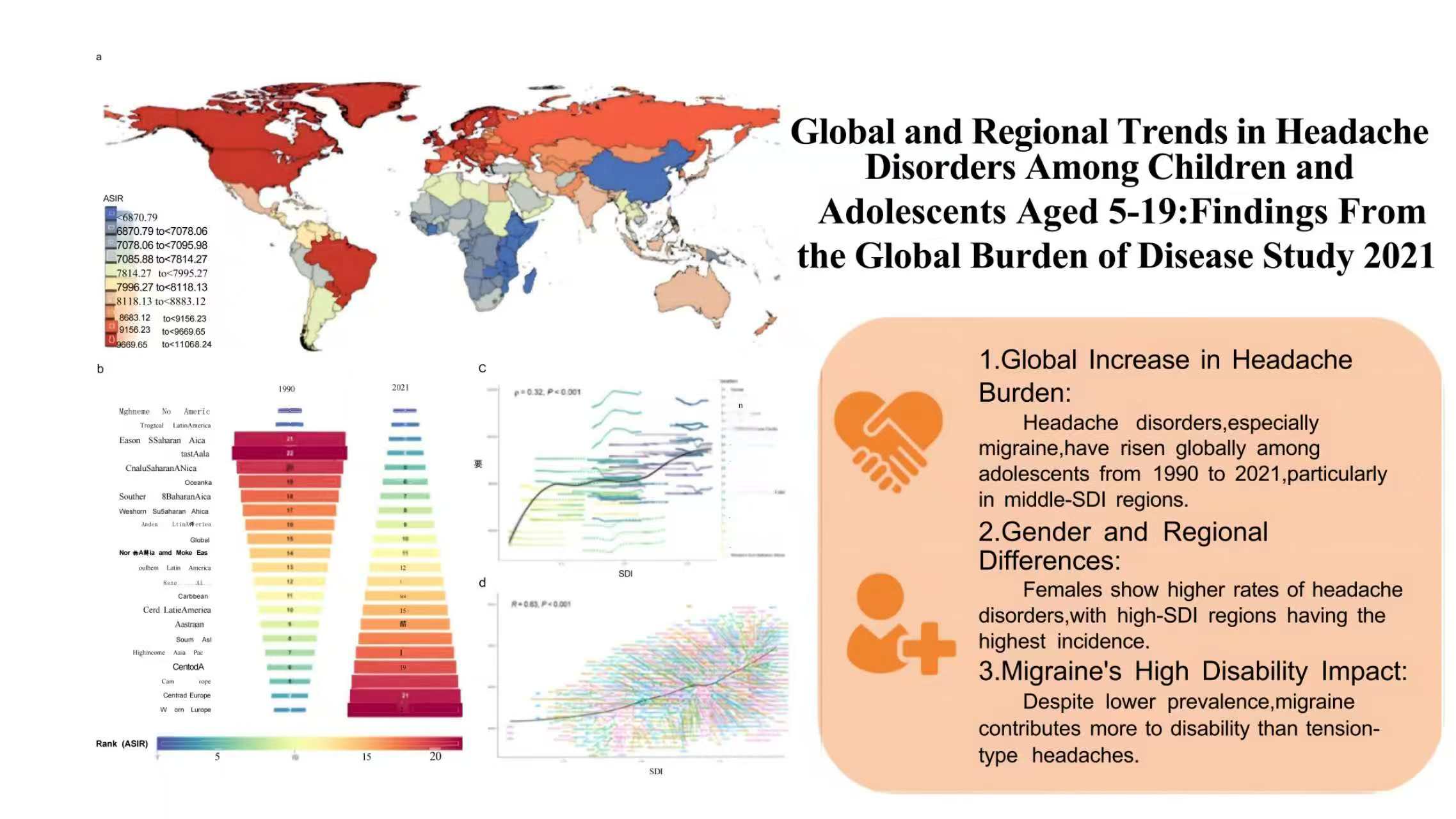
Background:As highlighted in the Global Burden of Disease (GBD) study, headache disorders represent a major cause of non-fatal disease burden worldwide, given their widespread prevalence and impact on daily functioning.In recent years, the prevalence of headache disorders has risen substantially among children and adolescents, with significant repercussions for their daily functioning and overall well-being. However, despite their growing impact, there remains a critical shortage of comprehensive investigations into the burden and long-term implications of these conditions in younger populations. This study systematically assesses the global and regional burden of headache disorders in individuals aged 5 to 19 years over the period 1990 to 2021, aiming to generate high-resolution epidemiological insights to inform public health strategies and guide data-driven policy decisions.
Methods:The 2021 iteration of the GBD study quantified the impact of 371 diseases and injuries through estimates of disability-adjusted life years (DALYs), incidence, and prevalence, integrating data from over 100,000 heterogeneous sources spanning registries, surveys, and health records. Data inputs included vital registration systems, verbal autopsies, national censuses, household surveys, disease-specific registries, healthcare utilization databases, and other relevant sources. DALYs were computed as the sum of years lived with disability (YLDs) and years of life lost (YLLs). YLDs were estimated by multiplying the prevalence of each health sequela—stratified by cause, age, sex, location, and year—by its assigned disability weight. In parallel, YLLs were computed by applying the standard life expectancy, derived from the reference life table, to the number of deaths within each demographic subgroup.
Results:From 1990 to 2021, headache disorders consistently imposed a significant global burden on individuals aged 5 to 19. By 2021, the age-standardized incidence rate (ASIR) was 7,874 per 100,000, and the age-standardized prevalence rate (ASPR) reached 19,866 per 100,000, with a DALY rate of 294 per 100,000. Females consistently had higher rates than males across all indicators. Middle-SDI regions contributed the highest total number of cases and DALYs, while high-SDI regions had the highest age-standardized rates. Temporal trend analysis showed the steepest increase in DALY rates in middle- and high-middle-SDI regions, particularly among adolescents aged 15-19. Among headache subtypes, migraine, despite its lower prevalence, contributed more to DALYs due to its higher disability weight. Improved healthcare access and disease recognition in regions with advanced diagnostic infrastructure may lead to more accurate migraine diagnoses, while stigma and limited awareness can delay recognition, further exacerbating its disability burden.
Conclusion:Headache disorders remain a significant and persistent health burden among children and adolescents worldwide, with migraine contributing most to disability. Targeted interventions and integration of headache care into primary health systems are urgently needed to address this growing challenge.
Keywords:headache disorders, migraine, tension-type headache, incidence, prevalence, Global Burden of Disease (GBD), disability-adjusted life years (DALYs), epidemiology, adolescents, children.
Introduction
Headache disorders have been recognized by the Global Burden of Disease (GBD) study as a substantial global health issue, exerting considerable impact across diverse geographic and socio-economic settings [1] . Contrary to traditional assumptions that headache disorders primarily emerge in adulthood, accumulating evidence suggests that these conditions often originate in childhood or adolescence, as reported by Waliszewska-Prosol and Echiverri et al [2,3] .
To better understand the scope and significance of this issue, it is essential to consider both the clinical course and the long-term burden of headache in children and adolescents. Increasing evidence suggests that headache disorders in early life can have lasting consequences on overall well-being. Nearly 20% of children and adolescents report significant headache symptoms, with 7.81% and 14.97% meeting the diagnostic criteria for migraine and tension-type headache (TTH) [4] . If probable migraine is included, the prevalence is even higher. These conditions can have a profound impact on academic performance, school attendance, and quality of life [5] . Importantly, migraine symptoms often persist into adulthood for many individuals, underscoring the need for early intervention and effective long-term management [6] .
Despite these challenges, over two-thirds of pediatric patients respond well to available therapies, and those who benefit from early preventive treatment tend to maintain improved headache control later in life [6] . However, disparities in the distribution of health resources across regions and countries contribute to significant inequities in healthcare access, treatment opportunities, and the availability of medications, thereby hindering timely and effective management for certain populations [7] . This disparity not only limits patients’ access to timely and appropriate care, but also contributes to disease progression and heightened societal and economic burden. Accordingly, elevating awareness of this overlooked public health challenge is critical for driving policy change and improving outcomes [8] .
The 2021 iteration of the GBD initiative delivers novel insights into contemporary epidemiological patterns, facilitating a rigorous evaluation of worldwide health dynamics. Prior research has largely concentrated on quantifying headache-related morbidity within the under-50 demographic [9] ; although recent studies have begun to address the impact of these disorders in children and adolescents, there remains a notable gap in systematically evaluating their clinical and societal repercussions [10,11] .
Utilizing the most recent GBD 2021 repository, this investigation employs a stratified analytical approach to assess temporal variations in headache disorder epidemiology—encompassing incidence, prevalence, and disability-adjusted life years (DALYs)—spanning global, regional, and country-specific contexts between 1990 and 2021. The overarching objective of this research is to elevate recognition of headache disorders as a pressing public health priority, furnish empirically grounded recommendations for reducing their healthcare ramifications, and contribute to the establishment of sustainable public health approaches to manage their increasing welfare and economic impacts.
Method
Date sources
This study draws on data from the GBD 2021, the most recent and comprehensive assessment of global morbidity and mortality across 204 countries and territories. The GBD framework encompasses 369 diseases and injuries and 88 risk factors, integrating over 100,000 data sources—including national censuses, household surveys, vital registration systems, and peer-reviewed literature. For this analysis, age-specific estimates related to headache disorders in children and adolescents were extracted and analyzed [12,13] .
Data utilized in this study were retrieved from the Global Health Data Exchange (GHDx), the official repository of the GBD project (http://ghdx.healthdata.org/gbd-results-tool). The GHDx platform enables users to query disease burden metrics by age, sex, location, year, and other dimensions, allowing for detailed and reproducible data extraction.
Case Definitions and Disease Metrics
Within the GBD framework, headache disorders, including migraine and tension-type headache, are categorized based on diagnostic criteria consistent with the International Classification of Headache Disorders (ICHD). Their burden was assessed using standardized indicators such as incidence, prevalence, and DALYs. These estimates were generated through the application of Bayesian meta-regression, which integrates data from multiple sources and accounts for uncertainty. The use of Bayesian methods allows for the incorporation of prior knowledge and the estimation of uncertainty intervals, improving the robustness of burden estimates across different regions and time periods.
Population Scope and Age Group Selection
The analysis was specifically centered on individuals aged 5 to 19 years, corresponding to the pediatric and adolescent age range. Data for individuals under 5 years of age were excluded, primarily due to the unavailability and insufficient reliability of estimates for this subgroup in the GBD 2021 database. Although other recent studies have included this age group [11] , the exclusion was necessary for the integrity and comparability of the results within the context of this study's methodology and available data quality.
Geographic and Socio-demographic index (SDI)
To enable consistent cross-regional comparisons, GBD 2021 classifies all countries and territories into 21 geographic regions, grouped according to shared epidemiological characteristics and geographic proximity. This classification system, employed in successive GBD iterations, facilitates standardized analysis and enhances the interpretation of global health disparities [14] .
The Socio-demographic Index (SDI), formulated by the Institute for Health Metrics and Evaluation (IHME), functions as an integrative indicator reflecting a nation's overall developmental status. It is derived from three key dimensions: fertility rates in women younger than 25, mean educational attainment in individuals aged 15 and older, and lag-adjusted income per capita [15,16] . In the GBD 2021 framework, SDI values were normalized on a scale from 0 to 100, where higher scores correspond to greater income and educational attainment, and lower fertility rates. According to their SDI scores, all 204 countries and territories were categorized into five development strata: low, low-middle, middle, high-middle, and high [17] .
Data Analysis
All relevant data were obtained from the GHDx repository and underwent additional processing prior to analysis using R 4.1.0 with the statsmodels and survival packages for regression analysis. This study systematically investigated the burden of headache disorders among children and adolescents aged 5 to 19 years, spanning 204 countries and territories, over the three-decade period from 1990 to 2021. The core indicators assessed in this study included age-standardized incidence rate (ASIR), prevalence rate (ASPR), death rate (ASDR), and disability-adjusted life year rate (ASR-DALYs). Each metric was accompanied by a corresponding 95% uncertainty interval (UI) to reflect estimation precision. A 95% confidence interval (CI) that includes zero suggests that the observed average annual percentage change (AAPC) is not statistically significant, indicating no clear increasing or decreasing trend over time[18] .
To calculate the AAPC for each burden metric, we employed log-linear regression models in R with the lm() function, treating year as the independent variable and the burden measure (incidence, prevalence, or DALYs) as the dependent variable. The AAPC was calculated by deriving the annual percentage change over the selected periods based on the regression slopes. The use of log-linear regression models was preferred due to their ability to model exponential growth or decay in data over time, which is consistent with the trends observed in the GBD 2021 data. Model selection was performed using the Akaike Information Criterion (AIC), which helped identify the model that best balanced goodness-of-fit and model complexity[19] . This approach ensures the robustness of the estimates while minimizing overfitting, providing more reliable estimates for temporal trends in the burden of headache disorders.
To quantify the uncertainty of AAPC estimates, we calculated the 95% uncertainty intervals (UIs) for each burden metric. These UIs account for variability due to differences in data sources, model assumptions, and the inherent uncertainty in regions with limited reporting. The wide UIs indicate significant uncertainty in the estimates, reflecting data limitations and regional variations. These intervals were derived using Bayesian hierarchical models in R (brms package), which handle uncertainty from missing or incomplete data by incorporating information from regions with more reliable reporting. This approach provides more accurate estimates for regions with sparse data.
The observed trends should be interpreted with consideration of the data limitations and regional disparities in healthcare infrastructure, disease recognition, and reporting practices. The UIs were used to assess the robustness of the observed trends and the significance of burden changes over time. The presence of substantial uncertainty highlights the need for more region-specific data and improved reporting systems in future GBD iterations.
For the correlation analyses in the figures, Pearson’s correlation coefficient (r) was used, and statistical significance was tested using two-tailed p-values with a threshold of 0.05. Sample sizes were based on the available data points for each metric across regions and time periods. The 95% confidence intervals (CIs) for the correlation coefficients were included to provide insight into the precision of the correlations.
Data were organized and analyzed using standard statistical methods. Descriptive and trend analyses were performed to evaluate temporal and spatial variations in disease burden. Visualizations, including bar charts, heatmaps, and geographic distribution maps, were created to illustrate patterns across time, regions, age groups, and SDI strata. All figures were refined for clarity and consistency in publication.
This approach ensures that the GBD 2021 estimates are as robust as possible, despite challenges related to missing or incomplete data, and supports region-specific trends and global health burden assessments.
Results
Global level
Globally, headache disorders among individuals aged 5-19 years have remained a substantial public health concern, with a modest but discernible upward trend observed over the past three decades. In 2021, the ASIR reached 7,873.97 per 100,000 population (95%UI: 5533-10618.87), the ASPR was 19,865.95 per 100,000 (95%UI: 15639.9-24627.82), and the DALY rate stood at 294.12 per 100,000(95%UI: 25.91-707.49) (Table 1) . Across all three indicators, females persistently exhibited higher rates compared to their male counterparts (Table 1).
Table 1 Age-standardized incidence, prevalence and DALY rates of headache disorders in the children and adolescents aged 5 to 19 at the global and SDI regional levels in 1990 and 2021
|
ASR (95%UI) |
||||||||
|
Locations |
cause |
sex |
1990 Incidence (95% UI) |
2021 Incidence (95% UI) |
1990 Prevalence (95% UI) |
2021 Prevalence (95% UI) |
1990 DALYs (95% UI) |
2021 DALYs (95% UI) |
|
Global |
Headache disorders |
Both |
7831.7 |
7874.0 |
19673.3 |
19866.0 |
287.7 |
294.1 |
|
Global |
Headache disorders |
Male |
7281.0 |
7364.9 |
17879.3 |
18182.8 |
219.3 |
229.6 |
|
Global |
Headache disorders |
Female |
8407.8 |
8414.6 |
21542.6 |
21650.3 |
359.0 |
362.4 |
|
Global |
Migraine |
Both |
1344.7 |
1353.7 |
7315.8 |
7471.0 |
266.7 |
272.8 |
|
Global |
Migraine |
Male |
1012.0 |
1045.5 |
5471.7 |
5737.1 |
200.1 |
210.3 |
|
Global |
Migraine |
Female |
1693.1 |
1681.2 |
9236.0 |
9308.4 |
336.0 |
339.1 |
|
Global |
Tension-type headache |
Both |
6487.0 |
6520.3 |
14280.3 |
14364.9 |
21.0 |
21.3 |
|
Global |
Tension-type headache |
Male |
6269.0 |
6319.5 |
13781.4 |
13893.8 |
19.1 |
19.4 |
|
Global |
Tension-type headache |
Female |
6714.6 |
6733.5 |
14800.1 |
14864.2 |
23.0 |
23.4 |
|
High SDI |
Headache disorders |
Both |
9386.1 |
9485.1 |
22641.2 |
22852.3 |
302.4 |
310.5 |
|
High SDI |
Headache disorders |
Male |
8555.6 |
8664.0 |
20371.7 |
20596.9 |
215.4 |
222.2 |
|
High SDI |
Headache disorders |
Female |
10261.4 |
10356.0 |
25034.3 |
25249.4 |
394.2 |
404.3 |
|
High SDI |
Migraine |
Both |
1461.8 |
1512.1 |
7685.8 |
7917.5 |
276.9 |
284.7 |
|
High SDI |
Migraine |
Male |
983.4 |
1020.8 |
5315.0 |
5495.3 |
192.3 |
198.9 |
|
High SDI |
Migraine |
Female |
1965.8 |
2033.0 |
10186.1 |
10493.2 |
366.2 |
375.9 |
|
High SDI |
Tension-type headache |
Both |
7924.4 |
7973.0 |
17449.0 |
17517.3 |
25.5 |
25.8 |
|
High SDI |
Tension-type headache |
Male |
7572.2 |
7643.1 |
16662.9 |
16768.4 |
23.1 |
23.3 |
|
High SDI |
Tension-type headache |
Female |
8295.6 |
8323.0 |
18278.0 |
18313.6 |
28.0 |
28.4 |
|
High-middle SDI |
Headache disorders |
Both |
7409.6 |
7603.0 |
18424.6 |
19002.2 |
256.3 |
268.0 |
|
High-middle SDI |
Headache disorders |
Male |
6871.9 |
7074.5 |
16715.8 |
17334.6 |
191.6 |
204.2 |
|
High-middle SDI |
Headache disorders |
Female |
7973.7 |
8184.8 |
20211.4 |
20839.1 |
323.9 |
338.3 |
|
High-middle SDI |
Migraine |
Both |
1186.4 |
1225.0 |
6360.7 |
6645.6 |
234.7 |
245.8 |
|
High-middle SDI |
Migraine |
Male |
863.6 |
908.7 |
4649.0 |
4965.2 |
172.1 |
184.1 |
|
High-middle SDI |
Migraine |
Female |
1525.4 |
1572.9 |
8149.6 |
8496.8 |
300.2 |
313.7 |
|
High-middle SDI |
Tension-type headache |
Both |
6223.2 |
6378.1 |
13691.1 |
14095.6 |
21.6 |
22.2 |
|
High-middle SDI |
Tension-type headache |
Male |
6008.3 |
6165.8 |
13201.3 |
13608.8 |
19.5 |
20.1 |
|
High-middle SDI |
Tension-type headache |
Female |
6448.3 |
6611.8 |
14202.8 |
14631.8 |
23.7 |
24.6 |
|
Middle SDI |
Headache disorders |
Both |
7417.9 |
7758.3 |
18896.8 |
19791.8 |
287.2 |
302.8 |
|
Middle SDI |
Headache disorders |
Male |
6860.2 |
7227.5 |
17043.6 |
18013.4 |
217.8 |
234.5 |
|
Middle SDI |
Headache disorders |
Female |
8001.3 |
8332.3 |
20826.4 |
21712.9 |
359.4 |
376.6 |
|
Middle SDI |
Migraine |
Both |
1337.4 |
1377.0 |
7275.7 |
7663.7 |
267.5 |
282.1 |
|
Middle SDI |
Migraine |
Male |
1007.5 |
1058.5 |
5414.7 |
5837.1 |
199.8 |
215.5 |
|
Middle SDI |
Migraine |
Female |
1683.0 |
1721.7 |
9212.4 |
9636.4 |
338.0 |
354.0 |
|
Middle SDI |
Tension-type headache |
Both |
6080.5 |
6381.2 |
13423.9 |
14113.0 |
19.6 |
20.7 |
|
Middle SDI |
Tension-type headache |
Male |
5852.6 |
6169.0 |
12915.3 |
13630.3 |
18.0 |
18.9 |
|
Middle SDI |
Tension-type headache |
Female |
6318.3 |
6610.6 |
13953.4 |
14634.4 |
21.4 |
22.6 |
|
Low-middle SDI |
Headache disorders |
Both |
8280.8 |
8207.0 |
20968.3 |
20804.0 |
316.4 |
315.2 |
|
Low-middle SDI |
Headache disorders |
Male |
7805.7 |
7750.0 |
19269.9 |
19182.4 |
248.0 |
250.8 |
|
Low-middle SDI |
Headache disorders |
Female |
8778.9 |
8689.4 |
22735.2 |
22509.1 |
387.4 |
382.9 |
|
Low-middle SDI |
Migraine |
Both |
1459.5 |
1446.6 |
8159.4 |
8075.2 |
295.2 |
293.8 |
|
Low-middle SDI |
Migraine |
Male |
1146.4 |
1152.8 |
6305.0 |
6340.4 |
228.7 |
231.3 |
|
Low-middle SDI |
Migraine |
Female |
1788.1 |
1756.8 |
10085.8 |
9897.8 |
364.3 |
359.5 |
|
Low-middle SDI |
Tension-type headache |
Both |
6821.3 |
6760.5 |
14981.4 |
14868.3 |
21.2 |
21.4 |
|
Low-middle SDI |
Tension-type headache |
Male |
6659.3 |
6597.2 |
14596.2 |
14472.5 |
19.2 |
19.5 |
|
Low-middle SDI |
Tension-type headache |
Female |
6990.8 |
6932.5 |
15382.6 |
15284.6 |
23.1 |
23.4 |
|
Low SDI |
Headache disorders |
Both |
7111.7 |
7026.0 |
17957.7 |
17801.7 |
257.9 |
259.3 |
|
Low SDI |
Headache disorders |
Male |
6711.5 |
6618.2 |
16563.8 |
16401.3 |
208.4 |
210.6 |
|
Low SDI |
Headache disorders |
Female |
7526.0 |
7445.4 |
19394.1 |
19233.6 |
308.9 |
309.0 |
|
Low SDI |
Migraine |
Both |
1201.5 |
1197.8 |
6627.6 |
6605.0 |
238.4 |
239.7 |
|
Low SDI |
Migraine |
Male |
965.6 |
968.0 |
5280.3 |
5289.2 |
190.8 |
193.0 |
|
Low SDI |
Migraine |
Female |
1445.5 |
1434.0 |
8014.2 |
7948.3 |
287.5 |
287.4 |
|
Low SDI |
Tension-type headache |
Both |
5910.3 |
5828.2 |
12908.0 |
12750.4 |
19.5 |
19.6 |
|
Low SDI |
Tension-type headache |
Male |
5746.0 |
5650.2 |
12495.2 |
12306.9 |
17.6 |
17.6 |
|
Low SDI |
Tension-type headache |
Female |
6080.4 |
6011.4 |
13334.2 |
13204.7 |
21.4 |
21.6 |
Abbreviations: incidence, prevalence, DALYs, SDI, headache disorders, migraine, tension-type headache
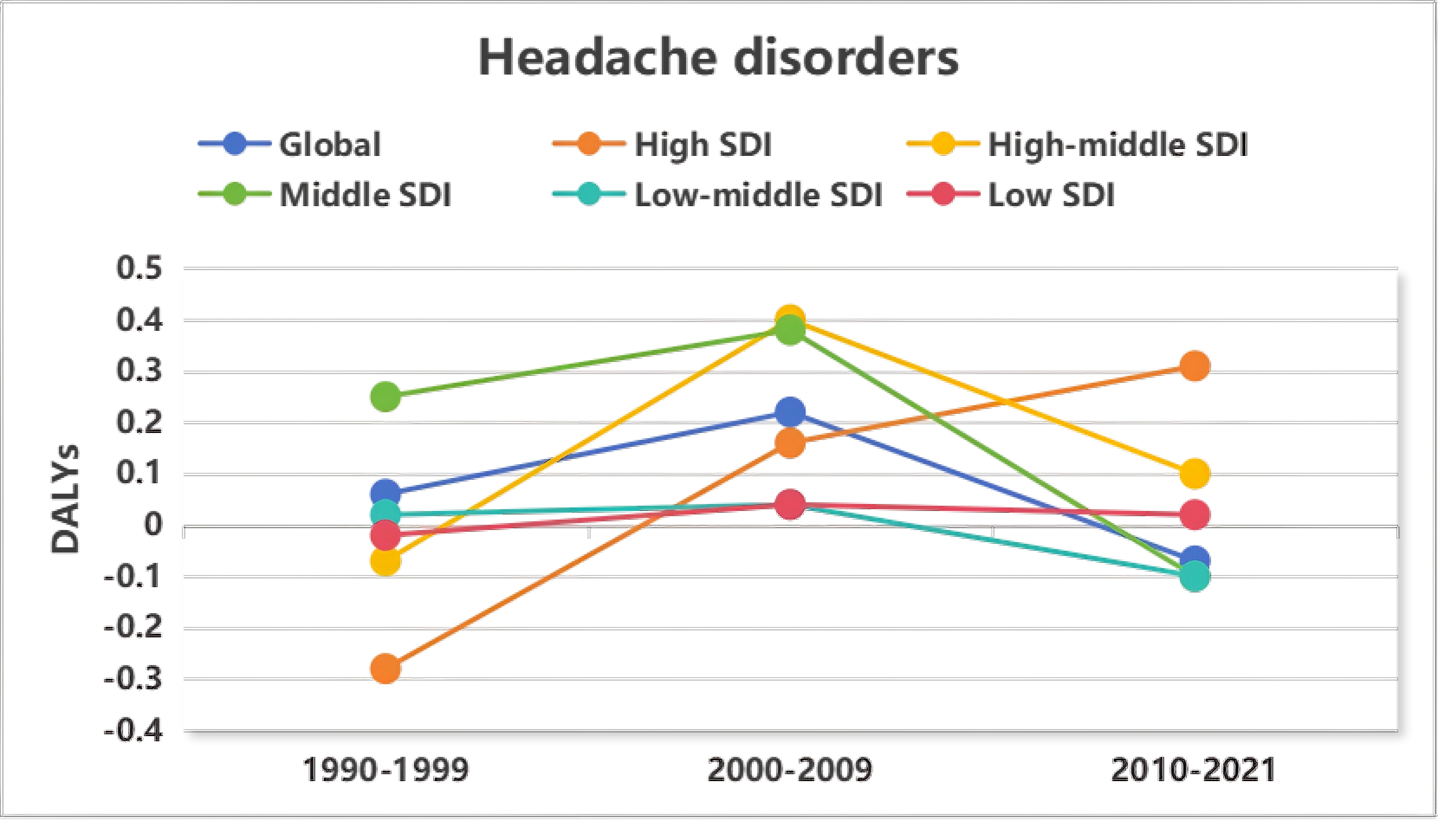
From 1990 to 2021, both ASIR and ASPR remained largely stable, whereas DALY rates increased modestly but significantly (Table 1). The most notable acceleration occurred during the period from 2000 to 2009, followed by a plateau or slight decline in subsequent years (Table 2 and Figure 1). Age-specific trend analysis revealed that adolescents aged 15-19 years experienced the sharpest rise in DALY rates, with an AAPC reaching 0.11, while children aged 5-9 years showed minimal or even negative change (Table 3).
Table 2 Changing trends of age-standardized incidence, prevalence and DALY rates of headache disorders in the children and adolescents aged 5 to 19 at the global and SDI regional levels in different period
|
Location |
Period |
AAPC (95% CI) |
|||||
|
|
|
Incidence |
Prevalence |
DALYs |
|||
|
|
|
95%CI |
Pval |
95%CI |
Pval |
95%CI |
Pval |
|
Headache disorders |
|||||||
|
Global |
1990-1999 |
-0.03 (-0.05, 0) |
0.038 |
0.01 (0, 0.02) |
0.027 |
0.06 (0.05, 0.07) |
< 0.001 |
|
|
2000-2009 |
0.12 (0.1, 0.14) |
< 0.001 |
0.12 (0.12, 0.13) |
< 0.001 |
0.22 (0.21, 0.23) |
< 0.001 |
|
|
2010-2021 |
-0.01 (-0.05, 0.02) |
0.426 |
-0.02 (-0.04, -0.01) |
0.006 |
-0.07 (-0.09, -0.04) |
< 0.001 |
|
High SDI |
1990-1999 |
-0.04 (-0.04, -0.04) |
< 0.001 |
-0.11 (-0.12, -0.11) |
< 0.001 |
-0.28 (-0.32, -0.24) |
< 0.001 |
|
|
2000-2009 |
0.02 (0, 0.03) |
0.015 |
0.02 (0.01, 0.03) |
< 0.001 |
0.16 (0.13, 0.18) |
< 0.001 |
|
|
2010-2021 |
0.11 (0.1, 0.12) |
< 0.001 |
0.15 (0.12, 0.18) |
< 0.001 |
0.31 (0.29, 0.33) |
< 0.001 |
|
High-middle SDI |
1990-1999 |
-0.13 (-0.14, -0.12) |
< 0.001 |
-0.08 (-0.09, -0.07) |
< 0.001 |
-0.07 (-0.1, -0.05) |
< 0.001 |
|
|
2000-2009 |
0.32 (0.31, 0.34) |
< 0.001 |
0.27 (0.25, 0.29) |
< 0.001 |
0.4 (0.35, 0.46) |
< 0.001 |
|
|
2010-2021 |
0.08 (0.06, 0.09) |
< 0.001 |
0.12 (0.11, 0.13) |
< 0.001 |
0.1 (0.07, 0.12) |
< 0.001 |
|
Middle SDI |
1990-1999 |
0.11 (0.05, 0.17) |
< 0.001 |
0.14 (0.09, 0.19) |
< 0.001 |
0.25 (0.21, 0.29) |
< 0.001 |
|
|
2000-2009 |
0.36 (0.27, 0.45) |
< 0.001 |
0.34 (0.32, 0.37) |
< 0.001 |
0.38 (0.35, 0.41) |
< 0.001 |
|
|
2010-2021 |
0.04 (0.02, 0.06) |
< 0.001 |
0.02 (0, 0.04) |
0.033 |
-0.1 (-0.15, -0.05) |
< 0.001 |
|
Low-middle SDI |
1990-1999 |
-0.05 (-0.07, -0.03) |
< 0.001 |
-0.02 (-0.02, -0.02) |
< 0.001 |
0.02 (0.01, 0.04) |
< 0.001 |
|
|
2000-2009 |
-0.03 (-0.04, -0.02) |
< 0.001 |
-0.01 (-0.02, 0) |
0.013 |
0.04 (0.03, 0.06) |
< 0.001 |
|
|
2010-2021 |
-0.01 (-0.03, 0.01) |
0.374 |
-0.04 (-0.05, -0.04) |
< 0.001 |
-0.1 (-0.13, -0.08) |
< 0.001 |
|
Low SDI |
1990-1999 |
-0.09 (-0.12, -0.07) |
< 0.001 |
-0.06 (-0.07, -0.05) |
< 0.001 |
-0.02 (-0.05, 0.02) |
0.338 |
|
|
2000-2009 |
-0.06 (-0.07, -0.05) |
< 0.001 |
-0.04 (-0.06, -0.03) |
< 0.001 |
0.04 (0, 0.07) |
0.031 |
|
|
2010-2021 |
0.03 (0.01, 0.05) |
0.002 |
0.02 (-0.01, 0.05) |
0.152 |
0.02 (-0.02, 0.06) |
0.365 |
|
Migraine |
|||||||
|
Global |
1990-1999 |
-0.1 (-0.11, -0.09) |
< 0.001 |
0.05 (0.03, 0.06) |
< 0.001 |
0.06 (0.05, 0.08) |
< 0.001 |
|
|
2000-2009 |
0.22 (0.19, 0.24) |
< 0.001 |
0.23 (0.22, 0.24) |
< 0.001 |
0.24 (0.23, 0.24) |
< 0.001 |
|
|
2010-2021 |
-0.07 (-0.11, -0.03) |
< 0.001 |
-0.06 (-0.1, -0.03) |
0.001 |
-0.07 (-0.1, -0.05) |
< 0.001 |
|
High SDI |
1990-1999 |
-0.19 (-0.21, -0.17) |
< 0.001 |
-0.29 (-0.32, -0.26) |
< 0.001 |
-0.3 (-0.34, -0.26) |
< 0.001 |
|
|
2000-2009 |
0.13 (0.12, 0.14) |
< 0.001 |
0.15 (0.14, 0.17) |
< 0.001 |
0.17 (0.15, 0.19) |
< 0.001 |
|
|
2010-2021 |
0.33 (0.32, 0.34) |
< 0.001 |
0.36 (0.34, 0.37) |
< 0.001 |
0.33 (0.31, 0.35) |
< 0.001 |
|
High-middle SDI |
1990-1999 |
-0.18 (-0.2, -0.17) |
< 0.001 |
-0.11 (-0.13, -0.09) |
< 0.001 |
-0.08 (-0.11, -0.06) |
< 0.001 |
|
|
2000-2009 |
0.53 (0.51, 0.55) |
< 0.001 |
0.42 (0.37, 0.46) |
< 0.001 |
0.43 (0.38, 0.49) |
< 0.001 |
|
|
2010-2021 |
-0.02 (-0.05, 0.01) |
0.283 |
0.1 (0.09, 0.12) |
< 0.001 |
0.09 (0.07, 0.12) |
< 0.001 |
|
Middle SDI |
1990-1999 |
-0.06 (-0.08, -0.03) |
< 0.001 |
0.23 (0.19, 0.27) |
< 0.001 |
0.25 (0.22, 0.29) |
< 0.001 |
|
|
2000-2009 |
0.43 (0.39, 0.48) |
< 0.001 |
0.39 (0.36, 0.42) |
< 0.001 |
0.4 (0.37, 0.43) |
< 0.001 |
|
|
2010-2021 |
-0.13 (-0.2, -0.05) |
0.001 |
-0.11 (-0.16, -0.05) |
< 0.001 |
-0.12 (-0.17, -0.07) |
< 0.001 |
|
Low-middle SDI |
1990-1999 |
-0.08 (-0.09, -0.07) |
< 0.001 |
0 (-0.01, 0.01) |
0.623 |
0.03 (0.01, 0.04) |
< 0.001 |
|
|
2000-2009 |
0.02 (0.01, 0.04) |
0.005 |
0.03 (0.01, 0.04) |
< 0.001 |
0.05 (0.03, 0.06) |
< 0.001 |
|
|
2010-2021 |
-0.03 (-0.06, 0) |
0.033 |
-0.13 (-0.15, -0.1) |
< 0.001 |
-0.12 (-0.15, -0.09) |
< 0.001 |
|
Low SDI |
1990-1999 |
-0.05 (-0.05, -0.04) |
< 0.001 |
-0.04 (-0.06, -0.01) |
0.002 |
-0.02 (-0.05, 0.02) |
0.422 |
|
|
2000-2009 |
0 (-0.02, 0.02) |
0.986 |
-0.01 (-0.03, 0.01) |
0.367 |
0.03 (0.02, 0.05) |
< 0.001 |
|
|
2010-2021 |
0.02 (-0.02, 0.06) |
0.363 |
0.01 (-0.02, 0.03) |
0.582 |
0.02 (-0.03, 0.07) |
0.396 |
|
Tension-type headache |
|||||||
|
Global |
1990-1999 |
-0.02 (-0.04, 0.01) |
0.166 |
-0.02 (-0.05, 0.01) |
0.253 |
0.03 (0, 0.05) |
0.046 |
|
|
2000-2009 |
0.09 (0.08, 0.11) |
< 0.001 |
0.09 (0.07, 0.12) |
< 0.001 |
0.05 (0.04, 0.05) |
< 0.001 |
|
|
2010-2021 |
0 (-0.04, 0.04) |
0.915 |
0.01 (0, 0.02) |
0.007 |
0.07 (0.06, 0.07) |
< 0.001 |
|
High SDI |
1990-1999 |
-0.01 (-0.02, -0.01) |
< 0.001 |
-0.08 (-0.09, -0.08) |
< 0.001 |
-0.02 (-0.03, -0.01) |
< 0.001 |
|
|
2000-2009 |
-0.01 (-0.02, 0) |
0.017 |
-0.02 (-0.04, 0) |
0.124 |
0.01 (-0.01, 0.04) |
0.265 |
|
|
2010-2021 |
0.07 (0.06, 0.07) |
< 0.001 |
0.11 (0.11, 0.12) |
< 0.001 |
0.11 (0.1, 0.12) |
< 0.001 |
|
High-middle SDI |
1990-1999 |
-0.12 (-0.13, -0.1) |
< 0.001 |
-0.07 (-0.08, -0.06) |
< 0.001 |
0.04 (0, 0.08) |
0.073 |
|
|
2000-2009 |
0.28 (0.27, 0.3) |
< 0.001 |
0.22 (0.2, 0.25) |
< 0.001 |
0.07 (0.04, 0.09) |
< 0.001 |
|
|
2010-2021 |
0.1 (0.09, 0.11) |
< 0.001 |
0.14 (0.13, 0.15) |
< 0.001 |
0.18 (0.14, 0.21) |
< 0.001 |
|
Middle SDI |
1990-1999 |
0.13 (0.07, 0.18) |
< 0.001 |
0.13 (0.06, 0.21) |
0.001 |
0.16 (0.1, 0.23) |
< 0.001 |
|
|
2000-2009 |
0.34 (0.27, 0.4) |
< 0.001 |
0.34 (0.29, 0.38) |
< 0.001 |
0.27 (0.23, 0.3) |
< 0.001 |
|
|
2010-2021 |
0.07 (0.05, 0.09) |
< 0.001 |
0.100 (0.07, 0.12) |
< 0.001 |
0.12 (0.1, 0.14) |
< 0.001 |
|
Low-middle SDI |
1990-1999 |
-0.04 (-0.05, -0.04) |
< 0.001 |
-0.03 (-0.04, -0.02) |
< 0.001 |
0.01 (0, 0.02) |
0.170 |
|
|
2000-2009 |
-0.04 (-0.04, -0.03) |
< 0.001 |
-0.03 (-0.04, -0.02) |
< 0.001 |
0 (-0.01, 0.02) |
0.611 |
|
|
2010-2021 |
0 (-0.01, 0) |
0.289 |
-0.01 (-0.01, 0) |
0.192 |
0.09 (0.07, 0.1) |
< 0.001 |
|
Low SDI |
1990-1999 |
-0.1 (-0.12, -0.09) |
< 0.001 |
-0.1 (-0.12, -0.07) |
< 0.001 |
-0.03 (-0.04, -0.01) |
0.011 |
|
|
2000-2009 |
-0.07 (-0.08, -0.06) |
< 0.001 |
-0.06 (-0.07, -0.05) |
< 0.001 |
-0.01 (-0.05, 0.04) |
0.780 |
|
|
2010-2021 |
0.03 (0.02, 0.04) |
< 0.001 |
0.03 (0.02, 0.05) |
< 0.001 |
0.09 (0.06, 0.13) |
< 0.001 |
Abbreviations: AAPC, incidence, prevalence, DALYs, period, SDI, headache disorders, migraine, tension-type headache
Table 3 Changing trends of age-specific incidence, prevalence and DALY rates of headache disorders in the children and adolescents aged 5 to 19 at the global and SDI regional levels in 1990 to 2021
|
Location |
Age |
AAPC (95% CI) |
|||||
|
|
|
Incidence |
Prevalence |
DALYs |
|||
|
|
|
95%CI |
Pval |
95%CI |
Pval |
95%CI |
Pval |
|
Headache disorders |
|||||||
|
Global |
5 to 9 |
-0.03 |
0.033 |
-0.02 |
0.111 |
0.03 |
0.053 |
|
|
10 to 14 |
0 |
0.650 |
0 |
0.957 |
0.04 |
0.002 |
|
|
15 to 19 |
0.09 |
< 0.001 |
0.08 |
< 0.001 |
0.11 |
< 0.001 |
|
High SDI |
5 to 9 |
-0.01 |
0.383 |
-0.01 |
0.064 |
0.03 |
0.248 |
|
|
10 to 14 |
0.04 |
< 0.001 |
0.02 |
0.002 |
0.06 |
< 0.001 |
|
|
15 to 19 |
0.06 |
< 0.001 |
0.05 |
< 0.001 |
0.1 |
< 0.001 |
|
High-middle SDI |
5 to 9 |
0.01 |
0.124 |
0.02 |
0.001 |
0.12 |
< 0.001 |
|
|
10 to 14 |
0.05 |
0.016 |
0.04 |
0.001 |
0.11 |
< 0.001 |
|
|
15 to 19 |
0.17 |
< 0.001 |
0.16 |
< 0.001 |
0.16 |
< 0.001 |
|
Middle SDI |
5 to 9 |
0.05 |
0.005 |
0.05 |
0.004 |
0.08 |
0.006 |
|
|
10 to 14 |
0.1 |
< 0.001 |
0.08 |
< 0.001 |
0.1 |
< 0.001 |
|
|
15 to 19 |
0.28 |
< 0.001 |
0.25 |
< 0.001 |
0.26 |
< 0.001 |
|
Low-middle SDI |
5 to 9 |
-0.03 |
0.008 |
-0.02 |
0.001 |
0.03 |
0.100 |
|
|
10 to 14 |
-0.04 |
< 0.001 |
-0.03 |
< 0.001 |
-0.01 |
0.518 |
|
|
15 to 19 |
-0.02 |
0.052 |
-0.02 |
0.024 |
-0.02 |
0.108 |
|
Low SDI |
5 to 9 |
-0.06 |
< 0.001 |
-0.06 |
< 0.001 |
0 |
0.970 |
|
|
10 to 14 |
-0.02 |
0.010 |
-0.02 |
0.007 |
0.01 |
0.406 |
|
|
15 to 19 |
-0.04 |
< 0.001 |
-0.02 |
0.001 |
0.03 |
0.123 |
|
Migraine |
|||||||
|
Global |
5 to 9 |
0.02 |
0.579 |
0.02 |
0.571 |
0.04 |
0.049 |
|
|
10 to 14 |
0.03 |
0.002 |
0.04 |
0.010 |
0.04 |
< 0.001 |
|
|
15 to 19 |
0.03 |
0.013 |
0.11 |
< 0.001 |
0.11 |
< 0.001 |
|
High SDI |
5 to 9 |
0.02 |
0.427 |
0.02 |
0.448 |
0.03 |
0.281 |
|
|
10 to 14 |
0.1 |
< 0.001 |
0.07 |
< 0.001 |
0.06 |
0.001 |
|
|
15 to 19 |
0.18 |
< 0.001 |
0.12 |
< 0.001 |
0.1 |
< 0.001 |
|
High-middle SDI |
5 to 9 |
0.12 |
< 0.001 |
0.12 |
< 0.001 |
0.13 |
< 0.001 |
|
|
10 to 14 |
0.1 |
< 0.001 |
0.11 |
< 0.001 |
0.12 |
< 0.001 |
|
|
15 to 19 |
0.11 |
< 0.001 |
0.16 |
< 0.001 |
0.16 |
< 0.001 |
|
Middle SDI |
5 to 9 |
0.06 |
0.038 |
0.06 |
0.039 |
0.07 |
0.124 |
|
|
10 to 14 |
0.09 |
< 0.001 |
0.1 |
< 0.001 |
0.1 |
< 0.001 |
|
|
15 to 19 |
0.15 |
< 0.001 |
0.26 |
< 0.001 |
0.26 |
< 0.001 |
|
Low-middle SDI |
5 to 9 |
0 |
0.903 |
0 |
0.955 |
0.03 |
0.126 |
|
|
10 to 14 |
-0.03 |
< 0.001 |
-0.03 |
0.051 |
-0.01 |
0.434 |
|
|
15 to 19 |
-0.03 |
0.034 |
-0.04 |
0.012 |
-0.02 |
0.076 |
|
Low SDI |
5 to 9 |
-0.04 |
0.019 |
-0.04 |
0.023 |
0 |
0.983 |
|
|
10 to 14 |
0.01 |
0.732 |
0 |
0.963 |
0.02 |
0.001 |
|
|
15 to 19 |
0.02 |
0.158 |
0 |
0.589 |
0.03 |
0.146 |
|
Tension-type headache |
|||||||
|
Global |
5 to 9 |
-0.04 |
0.004 |
-0.05 |
< 0.001 |
-0.01 |
0.155 |
|
|
10 to 14 |
-0.01 |
0.233 |
-0.02 |
0.013 |
0.01 |
0.039 |
|
|
15 to 19 |
0.1 |
< 0.001 |
0.08 |
< 0.001 |
0.07 |
< 0.001 |
|
High SDI |
5 to 9 |
-0.01 |
0.484 |
-0.02 |
0.324 |
0.01 |
0.371 |
|
|
10 to 14 |
0.02 |
< 0.001 |
0.01 |
0.527 |
0.04 |
< 0.001 |
|
|
15 to 19 |
0.04 |
< 0.001 |
0.04 |
< 0.001 |
0.05 |
< 0.001 |
|
High-middle SDI |
5 to 9 |
-0.01 |
0.084 |
-0.01 |
0.222 |
0.01 |
0.267 |
|
|
10 to 14 |
0.03 |
0.081 |
0.02 |
0.101 |
0.04 |
0.027 |
|
|
15 to 19 |
0.18 |
< 0.001 |
0.18 |
< 0.001 |
0.14 |
< 0.001 |
|
Middle SDI |
5 to 9 |
0.05 |
0.001 |
0.04 |
0.079 |
0.08 |
< 0.001 |
|
|
10 to 14 |
0.11 |
< 0.001 |
0.08 |
< 0.001 |
0.11 |
< 0.001 |
|
|
15 to 19 |
0.3 |
< 0.001 |
0.29 |
< 0.001 |
0.23 |
< 0.001 |
|
Low-middle SDI |
5 to 9 |
-0.03 |
0.001 |
-0.03 |
< 0.001 |
0.03 |
0.002 |
|
|
10 to 14 |
-0.03 |
< 0.001 |
-0.03 |
< 0.001 |
0.03 |
< 0.001 |
|
|
15 to 19 |
-0.02 |
0.053 |
-0.02 |
< 0.001 |
0.03 |
< 0.001 |
|
Low SDI |
5 to 9 |
-0.07 |
< 0.001 |
-0.07 |
< 0.001 |
-0.01 |
0.175 |
|
|
10 to 14 |
-0.03 |
0.001 |
-0.03 |
< 0.001 |
0.03 |
0.001 |
|
|
15 to 19 |
-0.04 |
< 0.001 |
-0.04 |
< 0.001 |
0.03 |
< 0.001 |
Abbreviations: AAPC, incidence, prevalence, DALYs, age, SDI, headache disorders, migraine, tension-type headache
Figure 1. DALYs Trends of Headache Disorders Among Different SDI Regions.
Among the two primary headache subtypes, migraine emerged as the predominant contributor to global DALYs, despite its lower incidence compared to tension-type headache. In 2021, the DALY rate attributable to migraine was 272.81 per 100,000 (95%UI: 17.5-681.64), markedly higher than that of tension-type headache, which was only 21.31 per 100,000 (95%UI: 17.5-681.64) (Table 1).
Regional level
Marked disparities in the burden of headache disorders were observed across SDI regions among children and adolescents aged 5–19 years. Throughout the study period, high-SDI regions consistently recorded the highest ASIR, ASPR, and DALY rates. In 2021, the DALY rate in high-SDI regions reached 310.47 per 100,000 population (95%UI: 26.97-742), whereas in low-SDI regions it was 259.30 per 100,000 (95%UI: 26.7-618.61) (Table 1).
Temporal trend analysis revealed that the most marked increases in DALY burden occurred in middle- and high-middle SDI regions. Notably, middle-SDI countries exhibited the steepest growth, with an AAPC of 0.17 (95% CI: 0.14-0.20), indicating a shifting concentration of disease burden in these transitioning socio-economic settings. High-middle SDI countries followed closely with an AAPC of 0.14 (95% CI: 0.12-0.16), suggesting that middle-income regions are experiencing a notable increase in headache-related morbidity (Table 4). Conversely, DALY rates in low- and low-middle SDI regions remained largely stable or exhibited slight declines, which may reflect limited healthcare resources and challenges in reporting (Table 4).
Across SDI regions, there were differing trends in DALY rates for headache disorders. Middle-SDI regions saw the most pronounced increases in age-standardized DALY rates, with consistent upward trends across all age groups. High-SDI regions showed moderate but steady increases in DALY rates and AAPC values, indicating ongoing public health challenges despite better healthcare systems (Table 4). In contrast, low-SDI regions demonstrated stable or slightly decreasing DALY rates, reflecting underreporting and limited diagnostic capacity.
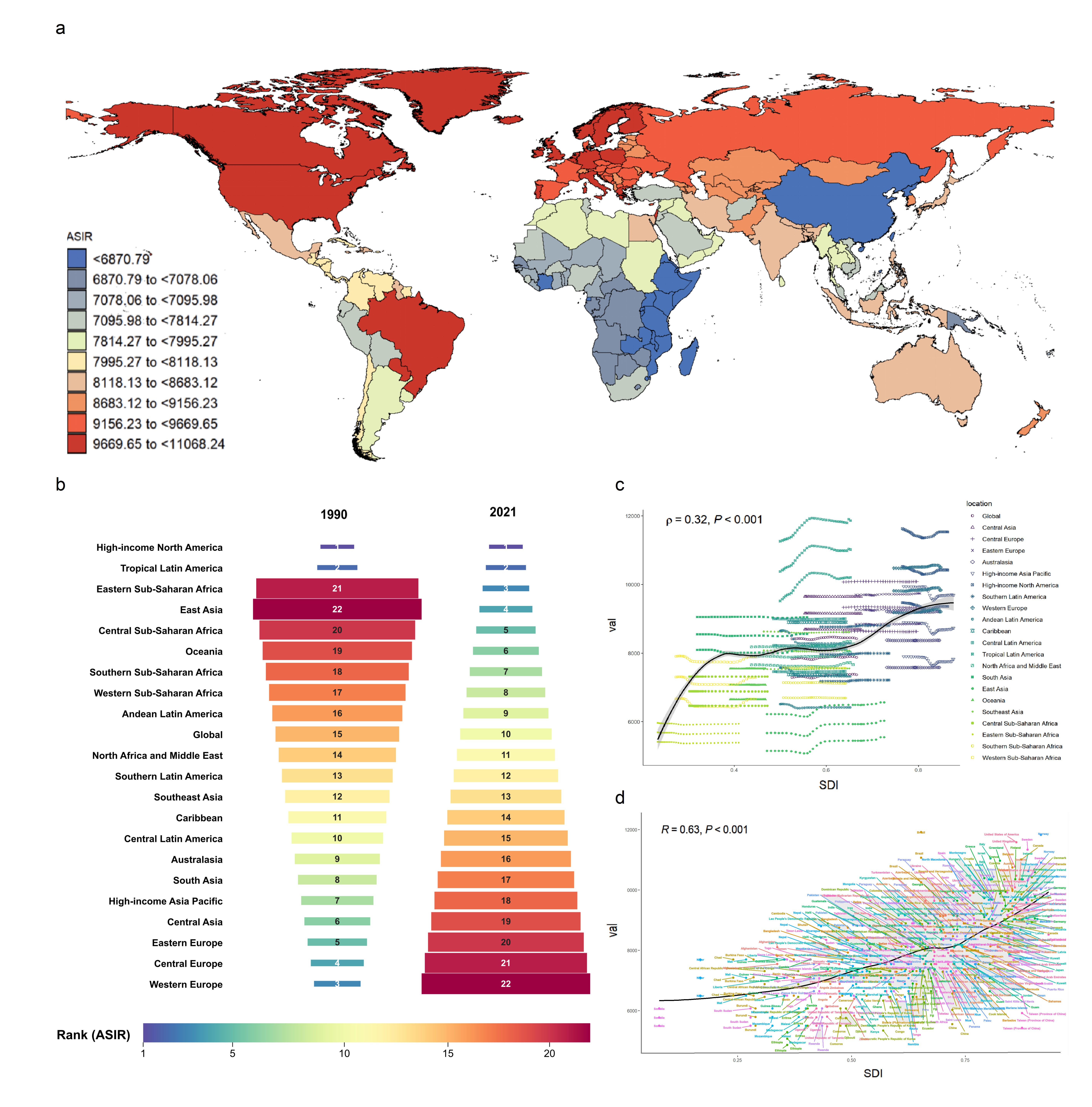
When examining the ASIR of headache disorders, high-SDI regions recorded the highest rates, reaching 9,485.06 per 100,000 population (95% UI: 6,541.11-12,950.74) (Table 1). Notably, Western Europe reported the highest ASIR, followed by Central Europe (Figure 2b). Temporal changes in ASIR from 1990 to 2021 were diverse across global regions. High-SDI regions saw a modest but persistent upward trend (AAPC: 0.04 per 100,000 population; 95% UI: 0.03-0.04), with increases observed in both high-middle SDI regions (AAPC: 0.08 per 100,000 population; 95% UI: 0.07-0.09). In contrast, low-SDI regions experienced a slight decline in ASIR (AAPC: -0.04 per 100,000 population; 95% UI: -0.05 to -0.03), potentially due to limited access to healthcare services and diagnostic capabilities. Interestingly, middle-SDI regions showed a more pronounced increase in ASIR (AAPC: 0.15 per 100,000 population; 95% UI: 0.12-0.18) (Table 4).
Figure 2. (a) Spatial distribution of ASIR for headache disorders among children and adolescents aged 5-19 in 2021. (b) Changes in regional rankings of age-standardized incidence rates (ASIR) for headache disorders between 1990 and 2021. (c) Correlation analysis between headache disorder incidence and SDI in children and adolescents aged 5-19 (p=0.32, P<0.001). (d) Regression analysis of headache disorder incidence across regional levels in children and adolescents aged 5-19 (R=0.63, P<0.001). Abbreviations: ASIR, age-standardized incidence rate.
Regarding the ASPR of headache disorders, high-SDI regions again recorded the highest rates, with an ASPR of 22,852.32 per 100,000 population (95% UI: 18,021.37-28,147.56). In contrast, low-SDI regions had the lowest ASPR at 17,801.73 per 100,000 (95% UI: 13,709.5-22,507.56) (Table 1). The most notable increase in ASPR was observed in middle-SDI regions, with an increase of 0.15 per 100,000 population (95% UI: 0.12-0.18), indicating a rising burden of headache disorders in these regions (Table 4).
In addition, examining the relative dominance of headache subtypes across regions, migraine showed a higher prevalence in high-SDI regions, particularly in Western and Central Europe, whereas TTH remained more common in low-SDI regions, reflecting differences in healthcare access and diagnostic practices. This regional disparity suggests that public health systems in higher-income countries may be better equipped to identify and report migraines, whereas in lower-income countries, the underreporting of migraines and the predominance of TTH could be more prevalent due to limited healthcare infrastructure.
Overall, the increasing trends of both migraine and TTH in middle and high SDI regions suggest the need for improved diagnostic practices and awareness, particularly in low-middle and low-SDI regions where data reliability and healthcare access remain key challenges.
National level
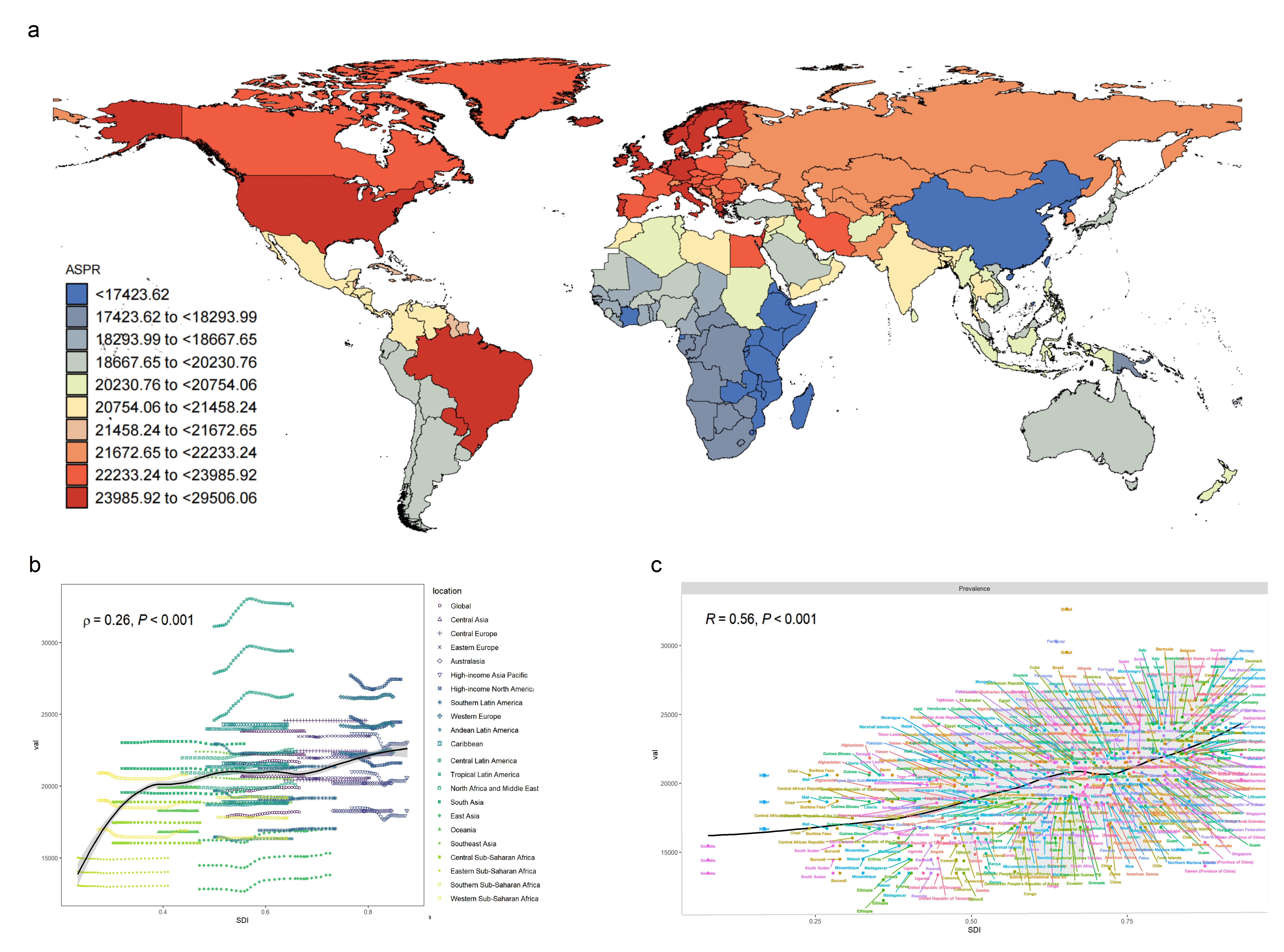
The ASPR of headache disorders varied considerably across different regions, with a global estimate of approximately 19,866 per 100,000 population in 2021 (Table 1). When analyzed by region, countries with the highest ASPRs were primarily concentrated in high-income areas, with Brazil (30,549.82 per 100,000; 95% UI: 25,453.51-36,237.40), Norway (28,972.32; 95% UI: 23,329.77-34,608.62), and Paraguay (27,031.98; 95% UI: 21,872.07-32,900.84) reporting the highest rates (Figure 3 and Table S1). In contrast, countries with lower rates tended to be concentrated in low-income regions, with Ethiopia (12,233; 95% UI: 8,918.03-15,824.41), the United Republic of Tanzania (14,037.18; 95% UI: 10,245.75-18,343.71), and Rwanda (14,474.25; 95% UI: 10,575.94-18,953.23) showing the lowest ASPRs (Figure 3 and Table S1).
Figure 3. (a) Spatial distribution of ASPR for headache disorders among children and adolescents aged 5-19 in 2021. (b) Correlation analysis between headache disorder prevalence and SDI in children and adolescents aged 5-19 (p=0.32, P<0.001). (c) Regression analysis of the headache disorder prevalence across national levels in children and adolescents aged 5-19 (R=0.63, P<0.001). Abbreviations: ASPR, age-standardized prevalence rate.
From 1990 to 2021, considerable regional variations in ASPR trends were observed. The most substantial relative increases occurred in countries within high-SDI regions, particularly in Norway (AAPC: 0.26; 95% CI: 0.20-0.32), Brazil (AAPC: 0.19; 95% CI: 0.17-0.21), and China (AAPC: 0.19; 95% CI: 0.16-0.22) (Table S2). These increases reflect significant changes in healthcare access, disease recognition, and possibly changes in lifestyle factors in these regions. Conversely, countries within low-SDI regions, such as Peru (AAPC: -0.19; 95% CI: -0.21 to -0.17) and Ethiopia (AAPC: -0.09; 95% CI: -0.09 to -0.09), reported the steepest declines in age-standardized incidence rates (ASIR) (Table S2). This divergence in trends may suggest differences in public health infrastructure and diagnostic capacity across regions.
These regional clusters provide a more meaningful interpretation of the data, highlighting the contrasting trends in high-income and low-income countries. Figure S1 and Table S2 offer further details on the country-specific distribution of ASIR across various regions.
Age and sex patterns
Across all age groups, females consistently exhibited higher age-standardized DALY rates for headache disorders compared to their male counterparts. In 2021, the global DALY rate reached 362.44 per 100,000 among females (95% UI: 30.91-878.96) and 229.63 per 100,000 among males (95% UI: 21.27-544.58) (Table 1). This difference was present across the children and adolescent age spectrum and appeared to intensify with increasing age.
Age-specific analysis further revealed that adolescents aged 15-19 years bore the heaviest burden and exhibited the fastest growth in DALY rates over the three-decade study period. From 1990 to 2021, the DALY rate in this group increased with an AAPC of 0.11 (95% CI: 0.09-0.14, p < 0.001). In contrast, the 10-14 age group showed a modest but statistically significant upward trend AAPC:0.04(95%CI:0.02-0.07)p=0.002 , while the 5-9 age group remained essentially unchanged AAPC:0.03(95%CI:0.00-0.07),p=0.053 (Table 3).
Patterns of incidence and prevalence followed a similar direction. In 2021, females exhibited higher ASIR and ASPR rates of headache disorders than males across all age groups (Table 1). Notably, the gap in ASPR between sexes widened with age, mirroring trends observed in DALY rates. This persistent divergence in age-specific and sex-specific rates suggests an accumulation of disease burden during adolescence, particularly among girls.
Headache subtypes level
Headache disorders in children and adolescents primarily comprise two subtypes: migraine and tension-type headache (TTH). Although TTH consistently showed higher incidence and prevalence rates, migraine remained the dominant contributor to overall disease burden due to its greater disability impact.
In 2021, the global age-standardized DALY rate for migraine was 272.81 per 100,000 population (95% UI: 17.5-681.64), significantly surpassing that of TTH, which was 21.31 per 100,000 (95% UI: 3.23-107.28) (Table 1). The same pattern was observed in 1990, indicating a persistent imbalance in disability burden between the two subtypes. While the ASIR for TTH exceeded 6,520 per 100,000 persons in 2021, compared to 1,353.67 per 100,000 persons (95% UI: 916.08-1871.46) for migraine (Table 1), the corresponding DALY burden for TTH remained minimal in comparison.
Over the past three decades, migraine-related DALY rates exhibited a consistent upward trend in the youth population. As shown in Table S2, the AAPC in DALY rates for migraine reached 0.07 (95% CI: 0.06-0.08, p < 0.001), reflecting a statistically significant increase. In comparison, the DALY rates for TTH increased modestly, with an AAPC of 0.04 (95% CI: 0.03-0.05) (Table 4). These results indicate that, while both subtypes have contributed to the overall rise in burden, migraine has played a more prominent role in shaping the temporal trends of headache-related disability among children and adolescents.
Discussion
This study utilized the most recent estimates from the GBD 2021 to analyze the incidence, prevalence, and DALYs of headache disorders among children and adolescents aged 5-19 years between 1990 and 2021. The overall burden of headache disorders in this age group remained substantial and demonstrated a gradual upward trend. Migraine emerged as the leading contributor to disability, underscoring the growing need for strengthened, age-tailored prevention and intervention strategies. This upward trend may reflect evolving lifestyle patterns in younger populations, including increased screen exposure, irregular sleep habits, and mounting psychological stress [20-22] . These changes, coupled with rapid shifts in societal behavior, may be contributing to the escalating prevalence of primary headache disorders in youth and warrant greater attention in both clinical practice and public health planning [23] .
Across all age groups and time periods, females consistently experienced a higher burden of headache disorders than males, highlighting persistent sex-based disparities. Neuroimaging studies, both structural and functional, have further substantiated this disparity [24] . Biological and psychosocial factors likely contribute to the higher prevalence of headaches in females. These factors may include hormonal fluctuations, genetic predisposition, increased exposure to environmental stressors, and sex-specific differences in pain sensitivity and stress responses. The onset of puberty and menarche is associated with a marked increase in headache prevalence among females, suggesting that estrogen and other sex hormones play a crucial role in headache pathophysiology. However, the role of sex hormones in other primary headache types, particularly in males, remains poorly understood, indicating that alternative mechanisms may be at play [25] . These findings underscore the need for sex-sensitive approaches in headache prevention and management, with particular attention to the impact of hormonal transitions at different life stages in females.
In addition to global trends, our analysis revealed significant disparities in the burden of headache disorders across SDI regions and countries. High-SDI regions exhibited the highest standardized incidence and prevalence rates of headache disorders, which may reflect superior diagnostic capabilities and more advanced healthcare systems. However, increased psychosocial stress and environmental factors, such as pollution associated with industrialization, may also contribute to the elevated burden in these regions [26,27] . Middle-SDI regions experienced the fastest increase in DALY rates for headache disorders over the past three decades, highlighting a growing unmet need in healthcare delivery and disease recognition. While economic development may have improved access to diagnosis, it has also introduced new challenges. Rapid urbanization and lifestyle changes—such as increased stress, reduced physical activity, poor sleep hygiene, and excessive screen exposure—are associated with the rising burden of headache disorders in middle-SDI regions. Additionally, sociocultural factors, including limited public awareness and persistent stigma surrounding headache disorders, may impede effective disease management, despite improvements in healthcare infrastructure [28,29] .
These differences in the burden of headache disorders across SDI regions are likely a result of diagnostic detection bias. High-SDI regions have better healthcare systems and diagnostic capacity, which leads to more cases being identified and reported. However, in low-SDI regions, where diagnostic and healthcare capabilities are relatively weaker, cases may go underreported or undiagnosed, resulting in a potentially underestimated disease burden. The true burden of headache disorders in low-SDI regions may be higher than reported, due to inadequate diagnostic infrastructure and limited access to healthcare services.To better understand the global burden of headache disorders, future studies should account for these potential biases by improving data collection in low-SDI regions and considering the impact of healthcare infrastructure on disease reporting. Additionally, strategies to reduce diagnostic disparities across regions could enhance the accuracy of global estimates and help inform public health interventions more effectively.
At the national level, China and Brazil showed significant increases in the burden of headache disorders over the past three decades. In China, both the ASPR and ASIR for migraine and TTH have steadily risen, reflecting the potential influence of socioeconomic development, urbanization, and evolving lifestyle patterns [29,30] . Furthermore, China's expanding healthcare infrastructure and greater awareness of non-communicable diseases may have improved diagnosis and reporting, resulting in higher recorded incidence rates. In Brazil, which has one of the highest migraine-related ASPRs among BRICS countries, there has been a recent stabilization in both prevalence and incidence trends. This stabilization may be linked to improved healthcare access, public health interventions, and increasing awareness of chronic diseases. However, despite this trend, the absolute number of headache cases continues to rise, which may still place considerable pressure on the healthcare system. This ongoing challenge emphasizes the need for targeted prevention strategies and healthcare management programs that address the growing burden of headaches, particularly in light of Brazil's increasing urbanization and social inequalities [29,31] .
In contrast, countries such as Ethiopia and Peru demonstrated slight declines in standardized DALY rates. These divergent trends emphasize the importance of tailoring national health strategies to country-specific epidemiological contexts and healthcare capacities, ensuring that prevention and intervention programs are responsive to local needs.
Taken together, the burden of headache disorders is on the rise. Our findings highlight the urgency of prioritizing headache disorders, particularly in children and adolescents, in international and national health agendas, given the significant differences in the burden of headache disorders across different ages, genders, regions, and countries [11] . Given the high prevalence, chronic nature, and disabling effects of migraines and TTH, these conditions are not merely isolated neurological disorders but constitute major public health challenges.
To effectively address the growing burden of headache disorders, health policies should prioritize the integration of headache management into primary healthcare systems, enhance provider training, raise public awareness, and ensure equitable access to diagnosis and treatment. In this context, several evidence-based prevention strategies can be considered. These include public education campaigns to raise awareness about headache triggers, promotion of sleep hygiene and stress management, and early screening in primary care settings. Particularly for school-aged populations, targeted educational programs and school-based health interventions may play a critical role [32,33] . Non-pharmacological approaches such as cognitive behavioral therapy (CBT) and lifestyle interventions have also been shown to be effective in reducing headache frequency and severity, especially among adolescents [34,35] . Implementing these strategies in a systematic and accessible way may significantly mitigate the long-term burden of headache disorders.
Our findings have important implications for refining clinical practice guidelines. By incorporating updated epidemiological evidence, guidelines can better identify high-risk populations and promote tailored, region-specific care models. In particular, aligning headache management strategies with regional burden profiles, especially for youth, can improve both access to care and health outcomes. Additionally, non-pharmacological, community-based preventive strategies have shown favorable cost-effectiveness in recent studies, underscoring their potential value in clinical practice [36,37] .
Building on these insights, the International Headache Society (IHS) has advocated for the global recognition of migraine as a treatable yet serious disorder, emphasizing its inclusion in public health policies. The IHS calls for structured treatment protocols, similar to those used for chronic diseases like hypertension, to address gaps in diagnosis and care. A unified approach to dispelling stigma, advancing research, and aligning national strategies with the WHO's Intersectoral Global Action Plan on Neurological Disorders (2022-2031) will ensure that headache disorders are prioritized and managed effectively on a global scale [38] .
To further strengthen this approach, our study's stratified burden patterns provide critical evidence to guide data-driven health policy decisions. Regions with rising DALY trends, particularly middle- and low-SDI countries, should be prioritized for awareness campaigns, enhanced diagnostic infrastructure, and the integration of headache management into primary care systems. These investments align with international initiatives, such as the Global Campaign against Headache and the WHO's action plan, reinforcing the need for scalable, evidence-based public health responses [39,40] .
Limitations
This study has several limitations that should be acknowledged. First, the analysis was based on secondary data from the GBD 2021 study, which, while comprehensive, does not include primary data collection. The accuracy of these estimates is inherently dependent on the availability and quality of underlying data, which can vary widely across countries and regions. In particular, low-SDI settings often lack comprehensive health surveillance systems, increasing the risk of underreporting or misclassification of headache disorders and likely resulting in an underestimation of the actual disease burden.
Second, although we focused on migraine and TTH, other headache disorders were not included, such as medication-overuse headache or rarer subtypes. This restriction may result in a partial representation of the total headache burden among children and adolescents.
Third, the diagnostic criteria used across different data sources and regions may vary, and GBD relies on diverse coding systems and survey instruments. These inconsistencies may introduce bias, especially in culturally diverse or resource-limited settings where diagnostic capacity is limited.
Fourth, while we analyzed time trends and age-sex differences, the observed increases in prevalence and DALYs might partially reflect improvements in diagnostic practices, increased awareness, or reporting bias over time. However, due to the ecological nature of the GBD data, it was not possible to disentangle the relative contributions of these factors.
Fifth, the absence of health system or policy variables in the analysis is another notable limitation. Without these variables, it is challenging to contextualize burden trends in terms of the effectiveness of healthcare interventions or the responsiveness of health systems to headache disorders. This omission limits the ability to assess how well healthcare systems are addressing the increasing burden of these disorders and the potential role of public health policies in mitigating this impact.
Lastly, the absence of individual-level clinical data limited our ability to explore associations with comorbidities, treatment patterns, and socioeconomic determinants, which are known to influence headache burden. Despite these limitations, the large-scale, standardized nature of GBD data, along with our age- and sex-specific trend analyses, provides valuable insights into the evolving burden of headache disorders in children and adolescents across global contexts.
Conclusion
This study evaluates the global and regional burden of headache disorders in individuals aged 5-19 years, based on the Global Burden of Disease 2021 data. The burden has remained high over the past three decades, with limited improvements, indicating that current interventions have had limited success. Migraine remains the leading cause of disability, while tension-type headache contributes less to DALYs.
Notably, females and older adolescents show higher rates. Middle-SDI regions saw the largest increases in DALYs, likely due to healthcare disparities. The variation across countries highlights the need for tailored responses.
To address this burden, public health strategies should integrate headache care into primary healthcare, promote education, and implement region-specific, evidence-based interventions. Key steps include expanding surveillance, including pediatric headaches in NCD strategies, funding school-based interventions, and exploring combined treatments like medication and non-invasive brain stimulation.
Non-pharmacological treatments, such as CBT and relaxation, should be integrated, especially where access to medication is limited. Community-based prevention strategies are essential for early diagnosis and reducing the burden, particularly in resource-limited areas. Future research should focus on social, economic, and cultural factors to guide tailored interventions.
Abbreviations
ASR: age-standardized rate; ASIR: age-standardized incidence rate; ASPR: age-standardized prevalence rate; DALY: disability-adjusted life year; YLD: years lived with disability; YLL: years of life lost; AAPC: average annual percentage change; SDI: socio-demographic index; GBD: Global Burden of Disease; GHDx: Global Health Data Exchange; TTH: tension-type headache; UI: uncertainty interval; CI: confidence interval; IHS: International Headache Society; WHO: World Health Organization.
Declarations
Author contributions
Ruofan Zhao and Xiaojing Yao conceptualized the study, designed the research methodology, and collected and ana-lyzed the data. Guizeng Zhao, as the corresponding author, contributed to the study concept and supervision. All authors were involved in drafting and finalizing the manuscript. All authors have given their approval for the submitted version of the manuscript.
Acknowledgements
Not applicable.
Funding information
The authors gratefully acknowledge the financial support from the Open Research Project of the Tuberculosis Research Insti-tute, Xinxiang Medical University (No. XYJHB202107), and the Youth Cultivation Fund Project of the First Affiliated Hospital of Xinxiang Medical University (No. QN-2022-B08).
Ethics approval and consent to participate
The authors affirm that written consent for publication was ob-tained from all participants involved in this study.
Competing Interests
The authors declare that they have no existing or potential commercial or financial relationships that could create a conflict of interest at the time of conducting this study.
Data Availability
All data needed to evaluate the conclusions in the paper are present in the paper or the Supplementary Materials. Additional data related to this paper may be requested from the authors.
References
[1] Collaborators G H. Global, regional, and national burden of migraine and tension-type headache, 1990-2016: a systematic analysis for the Global Burden of Disease Study 2016. Lancet Neurol. 2018;17(11):954-76.
[2] Echiverri K, Jicha G A, Smith J H. Age-Related Changes in Headache Days across the Cognitive Spectrum. Pain Med. 2018;19(7):1478-84.
[3] Waliszewska-Prosół M, Montisano D A, Antolak M, Bighiani F, Cammarota F, Cetta I, et al. The impact of primary headaches on disability outcomes: a literature review and meta-analysis to inform future iterations of the Global Burden of Disease study. J Headache Pain. 2024;25(1):27.
[4] Lu G, Xiao S, Wang Y, Jia Q, Liu S, Yu S, et al. Global epidemiology and burden of headache disorders in children and adolescents from 1990 to 2021. Headache. 2025.
[5] Onofri A, Pensato U, Rosignoli C, Wells-Gatnik W, Stanyer E, Ornello R, et al. Primary headache epidemiology in children and adolescents: a systematic review and meta-analysis. J Headache Pain. 2023;24(1):8.
[6] Szperka C. Headache in Children and Adolescents. Continuum (Minneap Minn). 2021;27(3):703-31.
[7] Raffaelli B, Rubio-Beltrán E, Cho S J, De Icco R, Labastida-Ramirez A, Onan D, et al. Health equity, care access and quality in headache - part 2. J Headache Pain. 2023;24(1):167.
[8] Meng W, Sui L. Headache disorders: a persistent public health challenge for the under 50s. Front Neurol. 2024;15:1501749.
[9] Chen Z F, Kong X M, Yang C H, Li X Y, Guo H, Wang Z W. Global, regional, and national burden and trends of migraine among youths and young adults aged 15-39 years from 1990 to 2021: findings from the global burden of disease study 2021. J Headache Pain. 2024;25(1):131.
[10] Lu G, Xiao S, Wang Y, Jia Q, Liu S, Yu S, et al. Global epidemiology and burden of headache disorders in children and adolescents from 1990 to 2021. Headache: The Journal of Head and Face Pain. 2025;n/a(n/a).
[11] Liu C, Wang Y, Liu M, Ma C, Ma C, Wang J, et al. Global, regional, and national burden and trends of tension-type headache among adolescents and young adults (15-39 years) from 1990 to 2021: findings from the Global Burden of Disease study 2021. Sci Rep. 2025;15(1):18254.
[12] Tuo Y, Li Y, Li Y, Ma J, Yang X, Wu S, et al. Global, regional, and national burden of thalassemia, 1990-2021: a systematic analysis for the global burden of disease study 2021. EClinicalMedicine. 2024;72:102619.
[13] Collaborators G D a I. Global burden of 369 diseases and injuries in 204 countries and territories, 1990-2019: a systematic analysis for the Global Burden of Disease Study 2019. Lancet. 2020;396(10258):1204-22.
[14] Collaborators G R F. Global burden of 87 risk factors in 204 countries and territories, 1990-2019: a systematic analysis for the Global Burden of Disease Study 2019. Lancet. 2020;396(10258):1223-49.
[15] Molassiotis A, Kwok S W H, Leung A Y M, Tyrovolas S. Associations between sociodemographic factors, health spending, disease burden, and life expectancy of older adults (70+ years old) in 22 countries in the Western Pacific Region, 1995-2019: estimates from the Global Burden of Disease (GBD) Study 2019. Geroscience. 2022;44(2):925-51.
[16] Collaborators G D a H. Global, regional, and national disability-adjusted life-years (DALYs) for 315 diseases and injuries and healthy life expectancy (HALE), 1990-2015: a systematic analysis for the Global Burden of Disease Study 2015. Lancet. 2016;388(10053):1603-58.
[17] Collaborators G D a I. Global incidence, prevalence, years lived with disability (YLDs), disability-adjusted life-years (DALYs), and healthy life expectancy (HALE) for 371 diseases and injuries in 204 countries and territories and 811 subnational locations, 1990-2021: a systematic analysis for the Global Burden of Disease Study 2021. Lancet. 2024;403(10440):2133-61.
[18] Zhang L, Tong Z, Han R, Li K, Zhang X, Yuan R. Spatiotemporal trends in global burden of rheumatic heart disease and associated risk factors from 1990 to 2019. Int J Cardiol. 2023;384:100-6.
[19] Kuiper R. AIC-type Theory-Based Model Selection for Structural Equation Models. Struct Equ Modeling. 2022;29(1):151-8.
[20] Dao J M, Qubty W. Headache Diagnosis in Children and Adolescents. Curr Pain Headache Rep. 2018;22(3):17.
[21] Xavier M K, Pitangui A C, Silva G R, Oliveira V M, Beltrão N B, Araújo R C. Prevalence of headache in adolescents and association with use of computer and videogames. Cien Saude Colet. 2015;20(11):3477-86.
[22] Alberti A. Headache and sleep. Sleep Med Rev. 2006;10(6):431-7.
[23] Reidy B L, Riddle E J, Powers S W, Slater S K, Kacperski J, Kabbouche M A, et al. Clinic-based characterization of continuous headache in children and adolescents: Comparing youth with chronic migraine to those with new daily persistent headache. Cephalalgia. 2020;40(10):1063-9.
[24] Maleki N, Linnman C, Brawn J, Burstein R, Becerra L, Borsook D. Her versus his migraine: multiple sex differences in brain function and structure. Brain. 2012;135(Pt 8):2546-59.
[25] Delaruelle Z, Ivanova T A, Khan S, Negro A, Ornello R, Raffaelli B, et al. Male and female sex hormones in primary headaches. J Headache Pain. 2018;19(1):117.
[26] Hong C, Liu Z, Gao L, Jin Y, Shi J, Liang R, et al. Global trends and regional differences in the burden of anxiety disorders and major depressive disorder attributed to bullying victimisation in 204 countries and territories, 1999-2019: an analysis of the Global Burden of Disease Study. Epidemiol Psychiatr Sci. 2022;31:e85.
[27] Ge R, Chang J, Cao Y. Headache disorders and relevant sex and socioeconomic patterns in adolescents and young adults across 204 countries and territories: an updated global analysis. J Headache Pain. 2023;24(1):110.
[28] Ge R, Chang J. Disease burden of migraine and tension-type headache in non-high-income East and Southeast Asia from 1990 to 2019. J Headache Pain. 2023;24(1):32.
[29] Zhang Y J, Li X Y, Guo Z L. Temporal trends of migraine and tension-type headache burden across the BRICS: implications from the Global Burden of Disease study 2019. Front Neurol. 2023;14:1307413.
[30] Yu S, Liu R, Zhao G, Yang X, Qiao X, Feng J, et al. The prevalence and burden of primary headaches in China: a population-based door-to-door survey. Headache. 2012;52(4):582-91.
[31] Queiroz L P, Silva Junior A A. The prevalence and impact of headache in Brazil. Headache. 2015;55 Suppl 1:32-8.
[32] Park D S, Han J, Torabi M, Forget E L. Managing mental health: why we need to redress the balance between healthcare spending and social spending. BMC Public Health. 2020;20(1):393.
[33] Heyland D K, Pope J P, Jiang X, Day A G. Determining the psychometric properties of a novel questionnaire to measure "preparedness for the future" (Prep FQ). Health Qual Life Outcomes. 2021;19(1):122.
[34] Bae J Y, Sung H K, Kwon N Y, Go H Y, Kim T J, Shin S M, et al. Cognitive Behavioral Therapy for Migraine Headache: A Systematic Review and Meta-Analysis. Medicina (Kaunas). 2021;58(1).
[35] Knestrick K E, Gibler R C, Reidy B L, Powers S W. Psychological Interventions for Pediatric Headache Disorders: A 2021 Update on Research Progress and Needs. Curr Pain Headache Rep. 2022;26(1):85-91.
[36] Haghdoost F, Togha M. Migraine management: Non-pharmacological points for patients and health care professionals. Open Med (Wars). 2022;17(1):1869-82.
[37] Baglioni V, Bozza F, Beatrice A, Cameli N, Colacino Cinnante E M, Lentini G, et al. Non-Pharmacological Treatments in Paediatric Migraine. J Clin Med. 2024;13(5).
[38] Peres M F P, Sacco S, Pozo-Rosich P, Tassorelli C, Ahmed F, Burstein R, et al. Migraine is the most disabling neurological disease among children and adolescents, and second after stroke among adults: A call to action. Cephalalgia. 2024;44(8):03331024241267309.
[39] Olesen J, Jensen R H. The Global Campaign Against Headache and its future relation to IHS and WHO. Cephalalgia. 2023;43(4):3331024231159625.
[40] Leonardi M, Martelletti P, Burstein R, Fornari A, Grazzi L, Guekht A, et al. The World Health Organization Intersectoral Global Action Plan on Epilepsy and Other Neurological Disorders and the headache revolution: from headache burden to a global action plan for headache disorders. J Headache Pain. 2024;25(1):4.
 Figures
 References
 Peer
Peer Information
Figure 1. DALYs Trends of Headache Disorders Among Different SDI Regions.
Figure 2. (a) Spatial distribution of ASIR for headache disorders among children and adolescents aged 5-19 in 2021. (b) Changes in regional rankings of age-standardized incidence rates (ASIR) for headache disorders between 1990 and 2021. (c) Correlation analysis between headache disorder incidence and SDI in children and adolescents aged 5-19 (p=0.32, P<0.001). (d) Regression analysis of headache disorder incidence across regional levels in children and adolescents aged 5-19 (R=0.63, P<0.001). Abbreviations: ASIR, age-standardized incidence rate.
Figure 3. (a) Spatial distribution of ASPR for headache disorders among children and adolescents aged 5-19 in 2021. (b) Correlation analysis between headache disorder prevalence and SDI in children and adolescents aged 5-19 (p=0.32, P<0.001). (c) Regression analysis of the headache disorder prevalence across national levels in children and adolescents aged 5-19 (R=0.63, P<0.001). Abbreviations: ASPR, age-standardized prevalence rate.
[1] Collaborators G H. Global, regional, and national burden of migraine and tension-type headache, 1990-2016: a systematic analysis for the Global Burden of Disease Study 2016. Lancet Neurol. 2018;17(11):954-76.
[2] Echiverri K, Jicha G A, Smith J H. Age-Related Changes in Headache Days across the Cognitive Spectrum. Pain Med. 2018;19(7):1478-84.
[3] Waliszewska-Prosół M, Montisano D A, Antolak M, Bighiani F, Cammarota F, Cetta I, et al. The impact of primary headaches on disability outcomes: a literature review and meta-analysis to inform future iterations of the Global Burden of Disease study. J Headache Pain. 2024;25(1):27.
[4] Lu G, Xiao S, Wang Y, Jia Q, Liu S, Yu S, et al. Global epidemiology and burden of headache disorders in children and adolescents from 1990 to 2021. Headache. 2025.
[5] Onofri A, Pensato U, Rosignoli C, Wells-Gatnik W, Stanyer E, Ornello R, et al. Primary headache epidemiology in children and adolescents: a systematic review and meta-analysis. J Headache Pain. 2023;24(1):8.
[6] Szperka C. Headache in Children and Adolescents. Continuum (Minneap Minn). 2021;27(3):703-31.
[7] Raffaelli B, Rubio-Beltrán E, Cho S J, De Icco R, Labastida-Ramirez A, Onan D, et al. Health equity, care access and quality in headache - part 2. J Headache Pain. 2023;24(1):167.
[8] Meng W, Sui L. Headache disorders: a persistent public health challenge for the under 50s. Front Neurol. 2024;15:1501749.
[9] Chen Z F, Kong X M, Yang C H, Li X Y, Guo H, Wang Z W. Global, regional, and national burden and trends of migraine among youths and young adults aged 15-39 years from 1990 to 2021: findings from the global burden of disease study 2021. J Headache Pain. 2024;25(1):131.
[10] Lu G, Xiao S, Wang Y, Jia Q, Liu S, Yu S, et al. Global epidemiology and burden of headache disorders in children and adolescents from 1990 to 2021. Headache: The Journal of Head and Face Pain. 2025;n/a(n/a).
[11] Liu C, Wang Y, Liu M, Ma C, Ma C, Wang J, et al. Global, regional, and national burden and trends of tension-type headache among adolescents and young adults (15-39 years) from 1990 to 2021: findings from the Global Burden of Disease study 2021. Sci Rep. 2025;15(1):18254.
[12] Tuo Y, Li Y, Li Y, Ma J, Yang X, Wu S, et al. Global, regional, and national burden of thalassemia, 1990-2021: a systematic analysis for the global burden of disease study 2021. EClinicalMedicine. 2024;72:102619.
[13] Collaborators G D a I. Global burden of 369 diseases and injuries in 204 countries and territories, 1990-2019: a systematic analysis for the Global Burden of Disease Study 2019. Lancet. 2020;396(10258):1204-22.
[14] Collaborators G R F. Global burden of 87 risk factors in 204 countries and territories, 1990-2019: a systematic analysis for the Global Burden of Disease Study 2019. Lancet. 2020;396(10258):1223-49.
[15] Molassiotis A, Kwok S W H, Leung A Y M, Tyrovolas S. Associations between sociodemographic factors, health spending, disease burden, and life expectancy of older adults (70+ years old) in 22 countries in the Western Pacific Region, 1995-2019: estimates from the Global Burden of Disease (GBD) Study 2019. Geroscience. 2022;44(2):925-51.
[16] Collaborators G D a H. Global, regional, and national disability-adjusted life-years (DALYs) for 315 diseases and injuries and healthy life expectancy (HALE), 1990-2015: a systematic analysis for the Global Burden of Disease Study 2015. Lancet. 2016;388(10053):1603-58.
[17] Collaborators G D a I. Global incidence, prevalence, years lived with disability (YLDs), disability-adjusted life-years (DALYs), and healthy life expectancy (HALE) for 371 diseases and injuries in 204 countries and territories and 811 subnational locations, 1990-2021: a systematic analysis for the Global Burden of Disease Study 2021. Lancet. 2024;403(10440):2133-61.
[18] Zhang L, Tong Z, Han R, Li K, Zhang X, Yuan R. Spatiotemporal trends in global burden of rheumatic heart disease and associated risk factors from 1990 to 2019. Int J Cardiol. 2023;384:100-6.
[19] Kuiper R. AIC-type Theory-Based Model Selection for Structural Equation Models. Struct Equ Modeling. 2022;29(1):151-8.
[20] Dao J M, Qubty W. Headache Diagnosis in Children and Adolescents. Curr Pain Headache Rep. 2018;22(3):17.
[21] Xavier M K, Pitangui A C, Silva G R, Oliveira V M, Beltrão N B, Araújo R C. Prevalence of headache in adolescents and association with use of computer and videogames. Cien Saude Colet. 2015;20(11):3477-86.
[22] Alberti A. Headache and sleep. Sleep Med Rev. 2006;10(6):431-7.
[23] Reidy B L, Riddle E J, Powers S W, Slater S K, Kacperski J, Kabbouche M A, et al. Clinic-based characterization of continuous headache in children and adolescents: Comparing youth with chronic migraine to those with new daily persistent headache. Cephalalgia. 2020;40(10):1063-9.
[24] Maleki N, Linnman C, Brawn J, Burstein R, Becerra L, Borsook D. Her versus his migraine: multiple sex differences in brain function and structure. Brain. 2012;135(Pt 8):2546-59.
[25] Delaruelle Z, Ivanova T A, Khan S, Negro A, Ornello R, Raffaelli B, et al. Male and female sex hormones in primary headaches. J Headache Pain. 2018;19(1):117.
[26] Hong C, Liu Z, Gao L, Jin Y, Shi J, Liang R, et al. Global trends and regional differences in the burden of anxiety disorders and major depressive disorder attributed to bullying victimisation in 204 countries and territories, 1999-2019: an analysis of the Global Burden of Disease Study. Epidemiol Psychiatr Sci. 2022;31:e85.
[27] Ge R, Chang J, Cao Y. Headache disorders and relevant sex and socioeconomic patterns in adolescents and young adults across 204 countries and territories: an updated global analysis. J Headache Pain. 2023;24(1):110.
[28] Ge R, Chang J. Disease burden of migraine and tension-type headache in non-high-income East and Southeast Asia from 1990 to 2019. J Headache Pain. 2023;24(1):32.
[29] Zhang Y J, Li X Y, Guo Z L. Temporal trends of migraine and tension-type headache burden across the BRICS: implications from the Global Burden of Disease study 2019. Front Neurol. 2023;14:1307413.
[30] Yu S, Liu R, Zhao G, Yang X, Qiao X, Feng J, et al. The prevalence and burden of primary headaches in China: a population-based door-to-door survey. Headache. 2012;52(4):582-91.
[31] Queiroz L P, Silva Junior A A. The prevalence and impact of headache in Brazil. Headache. 2015;55 Suppl 1:32-8.
[32] Park D S, Han J, Torabi M, Forget E L. Managing mental health: why we need to redress the balance between healthcare spending and social spending. BMC Public Health. 2020;20(1):393.
[33] Heyland D K, Pope J P, Jiang X, Day A G. Determining the psychometric properties of a novel questionnaire to measure "preparedness for the future" (Prep FQ). Health Qual Life Outcomes. 2021;19(1):122.
[34] Bae J Y, Sung H K, Kwon N Y, Go H Y, Kim T J, Shin S M, et al. Cognitive Behavioral Therapy for Migraine Headache: A Systematic Review and Meta-Analysis. Medicina (Kaunas). 2021;58(1).
[35] Knestrick K E, Gibler R C, Reidy B L, Powers S W. Psychological Interventions for Pediatric Headache Disorders: A 2021 Update on Research Progress and Needs. Curr Pain Headache Rep. 2022;26(1):85-91.
[36] Haghdoost F, Togha M. Migraine management: Non-pharmacological points for patients and health care professionals. Open Med (Wars). 2022;17(1):1869-82.
[37] Baglioni V, Bozza F, Beatrice A, Cameli N, Colacino Cinnante E M, Lentini G, et al. Non-Pharmacological Treatments in Paediatric Migraine. J Clin Med. 2024;13(5).
[38] Peres M F P, Sacco S, Pozo-Rosich P, Tassorelli C, Ahmed F, Burstein R, et al. Migraine is the most disabling neurological disease among children and adolescents, and second after stroke among adults: A call to action. Cephalalgia. 2024;44(8):03331024241267309.
[39] Olesen J, Jensen R H. The Global Campaign Against Headache and its future relation to IHS and WHO. Cephalalgia. 2023;43(4):3331024231159625.
[40] Leonardi M, Martelletti P, Burstein R, Fornari A, Grazzi L, Guekht A, et al. The World Health Organization Intersectoral Global Action Plan on Epilepsy and Other Neurological Disorders and the headache revolution: from headache burden to a global action plan for headache disorders. J Headache Pain. 2024;25(1):4.
Peer-review Terminology
Identity transparency: Single anonymized
Reviewer interacts with: Editor
Details
This is an open access article under the terms of the Creative Commons Attribution License(http://creativecommons.org/licenses/by/4.0/), which permits use, distribution and reproduction in any medium, provided the original work is properly cited.
Publication History
Received 2025-05-08
Accepted 2025-07-13
Published 2025-07-18